Running an online business means that you need to continually reach out to new customers and keep in touch with existing ones. Fortunately, there are many ways to do that. Social media platforms such as Facebook, Twitter, and YouTube are one crucial channel. In ordinary times, you’d be able to run events, but these are discouraged amid the COVID-19 pandemic.
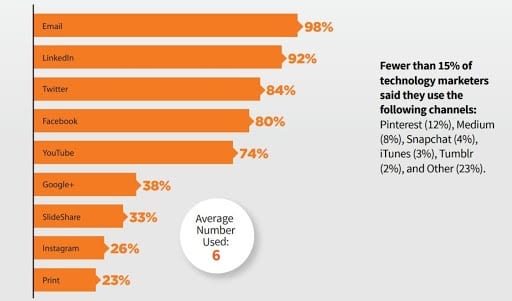
Amidst all these channels, there’s still one that easily trumps them all. Believe it or not, email is still the best way to market your products or services. Just ask 98% of marketers who say email is an integral part of their strategy:
Source: Content Marketing Institute
If you’re still not convinced, here are five reasons your business should shift to email marketing right now:
It’s Great for Customer Acquisition
If you aim to acquire new customers, email marketing is the way to go. According to Statista, there are 4.037 billion email users in 2020. This number is projected to increase to 4.481 billion by 2024. That’s a goldmine of potential customers!

Source: Statista
Despite the apparent ubiquity of social media, email is still the most accessed digital channel. 91% of consumers check their emails daily, and some check as many as 20 times per day! Workers dedicate an average of 2.5 hours per weekday to reviewing and responding to emails. Do you know how many emails are sent and received every day? 293.6 billion.
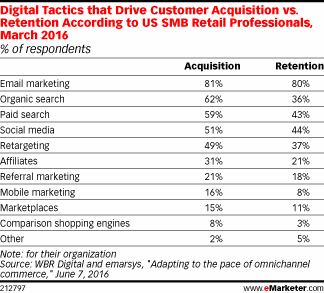
When it comes to customer acquisition, 81% of marketers believe email is still the main driver, as opposed to the 51% who said it was social media:
Source: eMarketer
While 60% of consumers sign up for promotions from brands via email, only 20% do so via social media platforms.
It Is Cost-Effective
Email marketing represents excellent value for money. Unlike traditional marketing channels, there are none of the costs associated with printing promotional materials, postage, ad space, or distribution costs. All you’ll need to pay for is an email ID finder and a reliable email marketing platform.
According to Lyfe, the median email marketing ROI is 122% (based on an eMarketer study.) That’s four times higher than any other digital marketing channel.
Here are some of the benefits your investment in email marketing will bring:
- It increases revenue. Multiply the number of conversions you made through email by the value of an average order so you can get a better idea of how much income you’re generating through your email marketing.
- It leads to higher sales conversions. You can keep in touch with interested consumers, providing the information and encouragement they need to make a purchase.
- It leads to increased website traffic. To measure the ROI for email campaigns intended to drive website traffic, look at the click-through rate or the click-to-open rates of your marketing emails.
- It increases brand awareness. Email campaigns help you communicate with leads repeatedly at set intervals. As a result, you can establish a relationship, build trust, and influence new customers’ conversions into loyal ones.
Email marketing is undoubtedly your best strategy for reaching both new and existing customers without blowing your budget.
It Is Personal
There’s a reason email marketing is so effective: It can (and should) be segmented and personalized. Targeted email campaigns enable you to establish and nurture stronger relationships with different groups of people. This type of targeted personalization increases engagement rates, according to 74% of marketers.
When you segment your email list, you can tailor your message and offer each customer group the value they are looking for. This is much more difficult to do with either social media or traditional print marketing.
Once you’ve segmented your email list, you also need to personalize each message. There are two main ways to do this: use the person’s name (in the email body and the subject line) and write as you would to a friend.
Personalizing subject lines can lead to open rates as high as 50%. Here’s an example:
 You should also greet the person by name at the opening of the email (“hey, Owen!”)
Writing as you would to a friend simply means using a warm, friendly tone and language that is not too formal. You should also write as though you are addressing one specific person. You want your recipient to feel as though you’re talking to them personally, not to a group of generic “customers.”
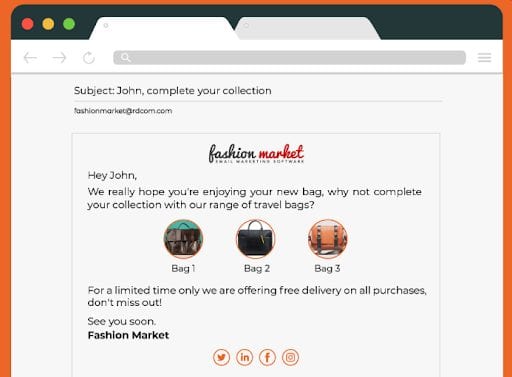
Here’s an excellent example from the ecommerce retailer Fashion Market:
Source: rdcom
Note that the email uses the recipient’s name both in the subject line and the body of the email, directly references a recent purchase, and uses informal, friendly language (“see you soon.”)
It is Designed to Trigger An Action
When you send an email, you should be very clear what action you hope the recipient will take. This will form the basis of your call to action (CTA,) whether it is signing up for an account, subscribing to your newsletter, or making a purchase.
A compelling CTA is concise, clear, and easily actionable. The recipient should immediately understand what you want them to do, and be able to do it in as few steps as possible. Here’s a strong example from Plated, a food subscription service:

Source: AdEspresso
The CTA is clear, and in just one click, the recipient can go through to a landing page where they can take action (in this case, signing up for a subscription.) This seamless experience is something that even the best print marketing materials can’t provide. If a prospective customer wants to buy something they’ve seen on a flyer, they have to make a call or browse manually to the website. Flyers can benefit your business in other ways, but email marketing is the best way to get customers to pay attention to your CTA.
Different email formats will have varied success rates in getting recipients to take action. I recommend running A/B tests to determine what works. Even a small change can make a big difference. For example, putting the CTA “Buy Now” above the email fold, as opposed to below, might have a substantial impact.
It Is Measurable.
One fantastic thing about email marketing is that you can track almost any metric you care to measure. Apart from the open rate, click-through rate, and click-to-open rate, you might wish to measure some or all of the following:
- Unsubscribe rate: Number of unsubscribes divided by the number of messages delivered.
- Complaint rate: Total complaints received divided by the number of messages delivered.
- Conversion rate: Number of conversions divided by the number of delivered emails.
- Bounce rate: Number of bounces divided by the number of delivered emails.
- Forward/share rate: Number of clicks on the share/forward button divided by delivered emails.
- List growth rate: Number of new subscribers minus the number of unsubscribes, plus email spam complaints divided by the number of new subscribers.
These metrics are critical in assessing how your email campaign is doing, which allows you to make adjustments to optimize results.
Email Marketing Is Not Dead
Even in this so-called golden age of social media, email remains the world’s number one preferred method of communication. According to Caylor Solutions, 73% of Millennials prefer to receive emails from businesses and organizations over all other means of communication. The same study found that 77% of people across the age spectrum prefer to receive promotional messages via email as opposed to direct mail, text, phone, or social media.
The expected continued growth in mobile device usage will further boost the popularity of email as a marketing platform. According to Campaign Monitor, from 2011 to 2013, the number of email opens on mobile devices increased 30%, with the upward trend expected to continue. One out of every three clicks in an email occurs on a mobile device, and 23% of readers reopen an email on a mobile device later.
All of this points to email marketing as something you should invest in urgently for your business. Just remember a few golden rules:
- Segment your data and personalize your email.
- Write as you would write to a friend.
- Make sure your email is free of grammatical and spelling mistakes. Use Grammarly or one of the great Grammarly alternatives to check your email before you send it.
- Conduct A/B testing to see what works.
- Track your metrics and amend your campaigns accordingly.
With global email usage still on the rise, the prospects are bright for email marketing. But you must be strategic if you want to build your business and nurture relationships with customers.
Do your research, strategize, think outside the box, and don’t be afraid to try things out. Following the rules will get you a long way, but your creativity and unique brand identity need to do the rest. With the vital tips above, hard work, and perseverance, you’ll soon see the wonders email marketing can do for your business.
Bio
Nico is an online marketer and the founder of Launch Space. He helps companies develop their digital marketing strategies. He’s worked with everyone from Fortune 500 companies to startups, helping them develop content marketing strategies that align with their business goals. Follow him on Twitter @nhdprins.