You may have heard about different kinds of Covid-19 tests, and each of them helps you achieve different goals, such as diagnosing a current viral infection or merely confirming if you have contracted the virus in the past.
With continuous research and technological advancement, individuals can buy Lateral Flow test Covid kits and conduct a test themselves quickly at home. This can also help screen a mass number of people at the airport or employees working in a company to prevent the viral infection from spreading.
No matter what, it’s important to be aware of the different types of Covid-19 tests, so you can get the right one for you. Keep reading this article to discover!
Different Types of Covid-19 Tests
There are 3 different types of Covid-19 tests – molecular tests (PCR), antigen tests, and antibody tests. Both molecular and antigen tests fall under the category of viral tests, as they help you detect a current virus.
Let’s take a look at each one of them in detail below:
1. Molecular Tests
Molecular tests are also called PCR (polymerase chain reaction), NAAT (nucleic acid amplification), and LAMP (loop-mediated isothermal amplification) tests. It is considered the most accurate to detect a current infection.
The RNA of a possible SARS-COV-2 virus (which causes coronavirus) is collected from a person’s nasal, throat, or saliva. Through the use of PCR machines, the single RNA sample is multiplied into a billion DNA copies to detect even the slightest traces of the virus.
Lab experts perform these tests as it requires knowledge and expertise. A molecular test can cost you around $100, and you can usually receive the result and report after 1 to 3 days.
2. Antigen Tests
Just like the molecular test help you identify current Covid-19 infection, so does the antigen test. However, it’s less accurate as compared to the molecular test.
Our bodies recognize antigens as foreign invaders such as bacteria, viruses, or chemicals and activate our immune response, releasing antibodies.
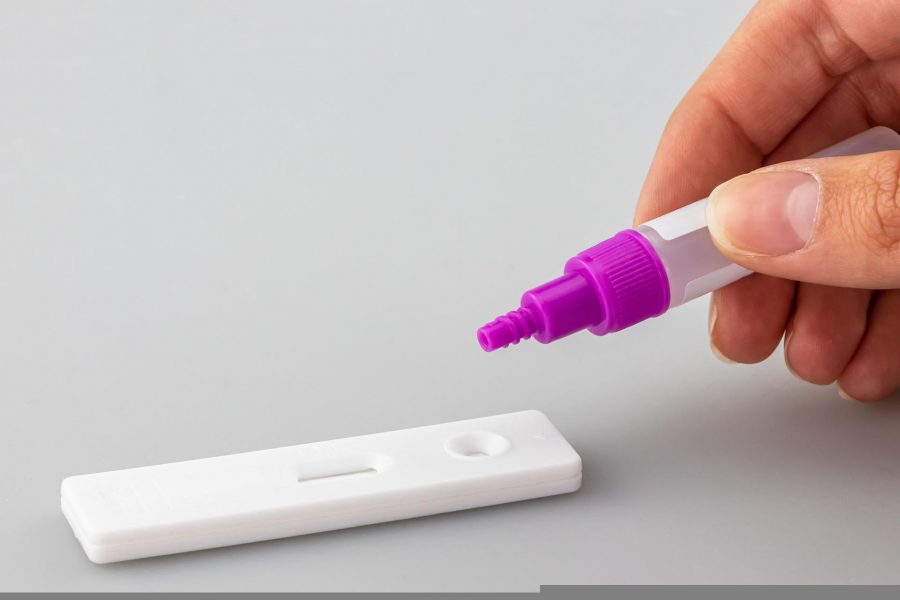
For an antigen test, a sample (antigens) is collected through a nasal or throat swab. This sample is mixed with a solution and put on a test strip containing antibodies specifically known as the SARS-COV-2 virus. If the antigens react to them, a colored line will appear, which means that the result is positive.
As antigen tests are less sensitive, they can’t accurately confirm the presence of a SARS-COV-2 virus if a person is asymptomatic or is in the early stage of infection.
However, these tests are simple to use, and you get the results within 15-30 minutes. They are also cheaper than PCR tests (around $5 to $50).
3. Antibody Tests
The antibody test is also referred to as a serological or serology test. What sets it apart from the other 2 tests is that this test only helps you determine if you’ve had coronavirus in the past.
This test particularly identifies antibodies that fight the SARS-COV-2 virus. Therefore, blood is either drawn from your arm or collected through a finger stick. It’s essential to consider here that your body needs 1 to 3 weeks to start releasing antibodies.
Hence, the test may not be accurate when symptoms develop after 1 week. Week 3rd usually gives the most accurate result.
You can also do this test yourself at home using a finger stick. Depending on the lab, you may get results on the same day or between 1 and 3 days. It will cost you around $30 to $50.
Which Covid-19 Test Should You Get?
Now that you’re familiar with the procedure, cost, at-home convenience, and turnaround time of the 3 tests. It all depends on what factors you prioritise the most and what you’re aiming for.
For instance, if you want to know if you have had Covid-19 previously, you may want to opt for an antibody test. An antigen test may be the right option for a company to ensure all employees are virus-free or even for an individual at home to rapidly identify the virus. However, if you’re looking for the most accurate test to diagnose current Covid-19, opting for the molecular test may be your best bet.