
As easy as it is to ignore air leaks and sweep them under the rug, it is estimated that 20%-40% of generated air in a manufacturing facility goes out to waste through air leaks. Even a small air system that is not adequately maintained will cost a business between £2-£7 a day, so you must identify and fix any leaks in your compressors as soon as possible.
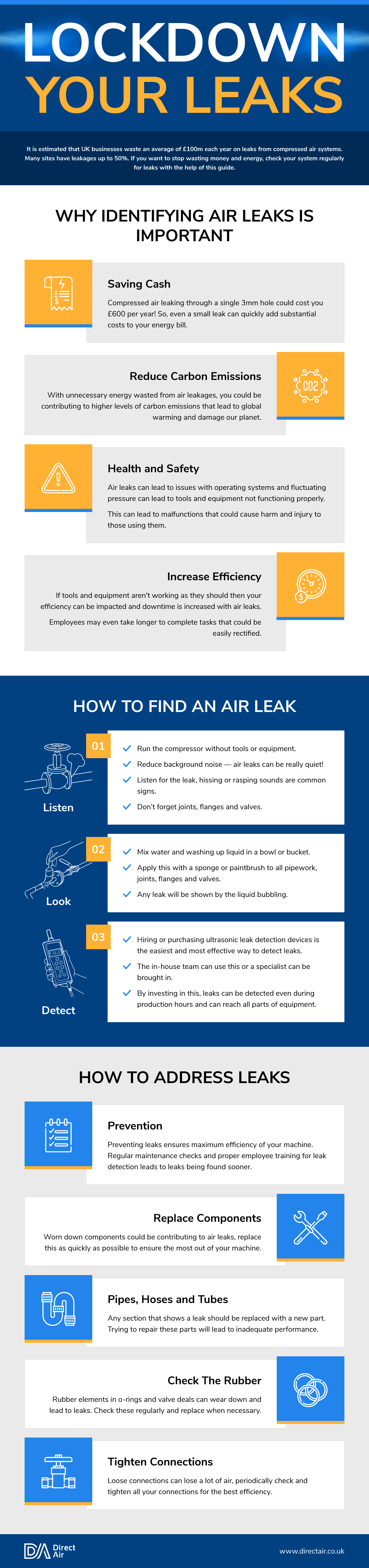 These leaks are a critical source of wasted energy as they cause a significant reduction in productivity and efficiency. If unattended to, they will eventually lead to outrageous maintenance costs.
Direct Air conducted some research to identify the impact that air leakages have on UK businesses, and you can find more information at https://www.directair.co.uk/news/lockdown-your-leaks/.
Pressure loss from holes or gaps in vessels, valves, or hoses negatively impacts plant operations. It means machinery won’t operate as well as it should, resulting in a loss – this explains why plant managers and engineers have to pay close attention to these issues and know what to do about them.
Why it is Important to Identify Air Leakages
Compressed air systems are useful tools in various industries. Although they are always an inevitable business expense, air leaks may be draining more money from your pocket each year in the form of unnecessary energy losses. Compressed air is one of the most costly — and essential — services in many industries, so even a small leak may be a financial drain on your business.
Converting electrical horsepower to compressed air power often requires a much higher volume of electrical horsepower. The typical estimate is that it takes between 7 and 8 HP of electrical power to generate 1 HP of compressed air power. When it comes to the costs of running an operating facility, compressed air is always more costly than electricity, natural gas, and water due to this device necessity, so whenever you have an air leak, you know money is also leaking.
How Air Leaks Are Detected
Listening
Listening for leaks is only possible during a shutdown when the entire system is so silent that massive leaks can be audible. Smaller leaks are below the hearing threshold; the lack of the hiss of leaking gas does not suggest that there are no leaks, and when you hear small leaks, they are challenging to pinpoint, particularly in areas difficult to access.
Looking
You can see leaks with this simple method – mix water and washing up liquid or soap in a bowl and work this into a lather. Use a sponge, cloth, or paintbrush to apply this to all pipework, not forgetting those joints, flanges, and valves.
Any air leaks will be made apparent by the mixture bubbling-easy! But this is a tedious task as you will have to go about to all individual parts of your compressor.
Detecting
Ultrasonic leak detectors can be purchased or hired and are the easiest and most effective way to find air leaks. In-house staff can use them. The best reason to use this method is to use these detectors during busy working hours and reach every part of your equipment, leaving no stone unturned and without interruption to production.
Finally, operators should ensure the information on each leak is stored in a spreadsheet – this helps to calculate the costs of fixing the leak and prioritize which leaks should be repaired first.