What artificial intelligence in HR does for a UK people team each week, and which HR tools charge extra for it
Monday morning in a UK HR team starts in the inbox, and that inbox is the fairest test of AI HR software. Someone who was off sick last week wants to know whether they’ll get SSP and when it shows up in their pay. A manager asks how much annual leave a part-timer has left before Christmas. Payroll cut-off is Wednesday and a new starter is still on an emergency tax code. The review cycle closes Friday, with forty unread self-assessments.
The fair measure for these assistants is a Monday like that: which of those jobs they take off the pile, from the record the HR system already holds, and what the vendor charges for it. A chatbot that explains SSP in general terms is no help. The question is whether it can see this person’s earnings and absence dates and answer for them.
Two questions run through all eight entries below: which of those Monday jobs the vendor’s named AI covers, and whether it comes with the HR licence or is billed on top. The best AI HR software UK companies can buy in 2026 answers both well, with the pay run its AI checks sitting inside the same product.
What AI HR software does for a UK company
AI in HR software, in the form these vendors ship it in 2026, is an assistant built into the HR system. It reads the employee record, the absence policies, the document library and, where the vendor runs payroll, the pay data. With that in front of it, the assistant does one of two things: answers a question from the data, or drafts something (a review summary, a report, a letter) for a person to check and approve. Where a vendor doesn’t run UK payroll, the assistant has nothing to say about tax codes or statutory pay.
The AI tools used in HR, task by task
Two of the Monday jobs are questions, and this is where most of the assistants start. “How much holiday have I got left?” needs the time-off policy and the absence record. “Do I get SSP for last week?” needs the absence dates and the earnings. Since 6 April 2026 there’s no waiting period or Lower Earnings Limit to apply, so the answer depends on whether the system that holds the absence also holds the pay. Policy questions sit in the same bucket: the handbook rule on carrying over leave, the notice period in a contract, what a right-to-work check needs. An assistant with permission-aware access to those documents answers them for the employee or the manager without an HR ticket.
The other two are drafting jobs. Before a UK pay run, the useful AI work is a check: entries that look wrong against last month, or a starter who arrived without a P45. After the run, it’s explaining a payslip to the person asking why their net pay moved. At review time, the assistant reads the self-assessments and peer feedback and writes the manager a first-pass summary of themes, and it does the same with open-text survey answers. Reporting works the same way: headcount or absence by team asked as a question rather than built as a report. In each case a person still signs off, and two of the eight vendors say so in writing.
The 8 best AI HR software platforms for UK teams
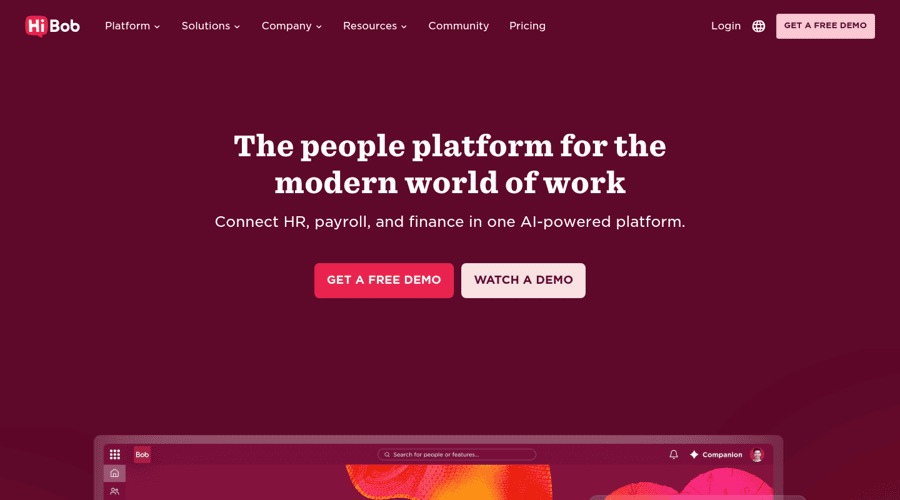
1. HiBob
Bob, HiBob’s platform, holds core HR and UK payroll with hiring, engagement, compensation, performance and workforce planning around them on one record, and Bob AI runs across all of it. Bob Companion is the front door: it takes a question in natural language and hands it to a specialised agent. It’s part of Bob Core, the foundation every customer starts on, so the assistant arrives with the licence, and the breadth of the record is what lets a team drop its separate review and survey tools.
On the Monday jobs: the Time Off Agent checks availability and answers the policy question behind a leave request, while Time Off itself works out SSP, maternity leave and holiday accrual and pushes approved absence straight into the pay run. The Payroll Agent explains payslips, the “why is my net pay lower” email. The Performance Agent summarises 360 reviews into themes and growth areas, the Surveys Agent reads engagement survey responses for theme and sentiment, and the Compensation Agent proposes explainable pay suggestions. Recognition and continuous feedback (goals, 1:1s) sit on the same record.
HiBob is clear about the limit. Bob AI doesn’t evaluate employees; managers and HR keep the decisions. Any AI action that would change company data waits for a person to approve it, admins can switch AI off from the AI Settings page, and HiBob’s stated position is zero data retention, customer data kept out of model training, and access that follows permissions. The AI pay-run preview that cuts reconciliation time is a US payroll feature. The UK side gets the payslip companion plus the alerts of a native, HMRC-recognised engine that syncs tax codes, files RTI/FPS and runs pension auto-enrolment.
HR, managers and employees share one modern interface they take to without a manual, which matters because an assistant only helps if the people asking are in the system. Policies, workflows and review templates follow the company’s own structure, and analytics and reporting are in Core. The people record spans countries: each person carries pay in their own currency, a language preference of their own and the leave rules that apply where they work, and hosting is GDPR-aligned, with customer data hosted in the EU. HiBob pitches Bob at companies from 50 employees upward into mid-market and multinational groups, has a customer base it puts at 5,500+ organisations in 170+ countries, and 2,711 G2 reviewers (count as of 26 October 2026) put it at 4.5/5. HiBob prices by quotation per head, beginning with Core and adding modules.
AI pricing: included. Bob Companion is listed inside Bob Core on HiBob’s pricing page, and HiBob publishes no separate AI tier or add-on.
Not covered by the AI: payroll outside the US and UK. Bob’s native payroll runs in those two countries; teams elsewhere connect their local provider through Payroll Hub, whose named integrations include Xero, ADP, TriNet and Paylocity, or use an EOR such as Papaya Global, Multiplier or Oyster, and the pay run sits with that provider.
2. Factorial
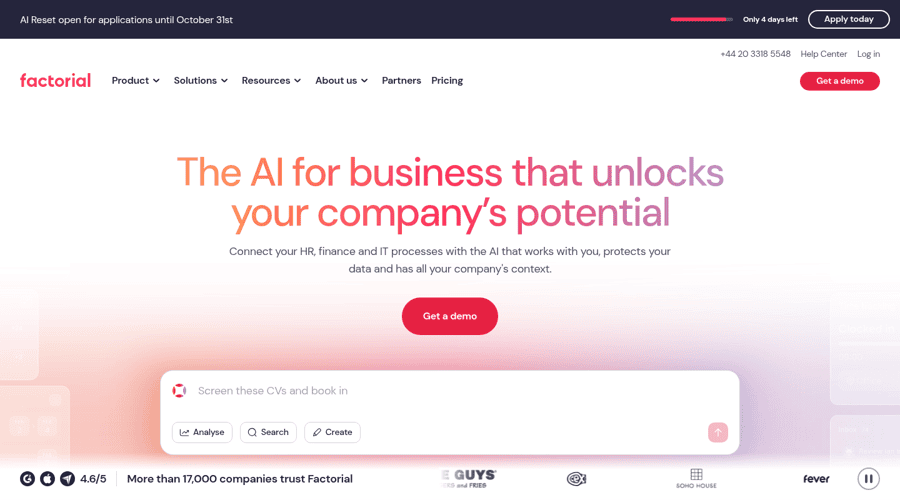
Factorial calls itself a European business management platform, and in the UK it sells modules such as performance and recruitment on top of Factorial Core, which starts at £5.40 per user monthly. Its AI is One, launched at Factorial Next: AI Edition 2025. Factorial describes One as a personal AI agent at work that knows the company, connects HR, Finance and IT, and turns that context into action, and it adds that One asks before it acts.
Mapped to the UK jobs, the documented work is payroll and recruiting. One flags anomalies before payroll runs. In recruiting it drafts the job description, calls candidates and runs the first screening, and the Recruitment module summarises applicants with AI. On absence, the Time Off module lets you set any number of leave policies and your own absence categories, but Factorial’s pages don’t attach an AI task to SSP or statutory leave. The Performance module’s 360 reviews are listed without an AI summary. Factorial’s privacy page puts its hosting in the EU.
The UK payroll position takes some reading. Factorial’s UK payroll page is titled Payroll Preparation: Core walks you through the payroll run and distributes the payslips, pay data syncs to connected providers (Payflow, Zuchetti, Primavera and Sage are named) or goes to your bookkeeper, and a single PDF of payslips is split into one file per employee. Factorial’s UK pages make no HMRC or RTI submission claim. Anything above Core comes as a bespoke bundle, priced in a sales conversation, and Factorial scored 4.4/5 on G2 (110 reviews, 26 October 2026).
AI pricing: not stated. Factorial’s UK pricing page puts Core at £5.40 per user monthly and quotes the rest; it doesn’t say whether One is inside Core or priced on top.
Not covered by the AI: the UK pay run. Factorial UK prepares payroll and distributes payslips; the submission happens in whichever provider or bookkeeper you connect, and Factorial’s UK pages make no HMRC or RTI claim.
3. Personio
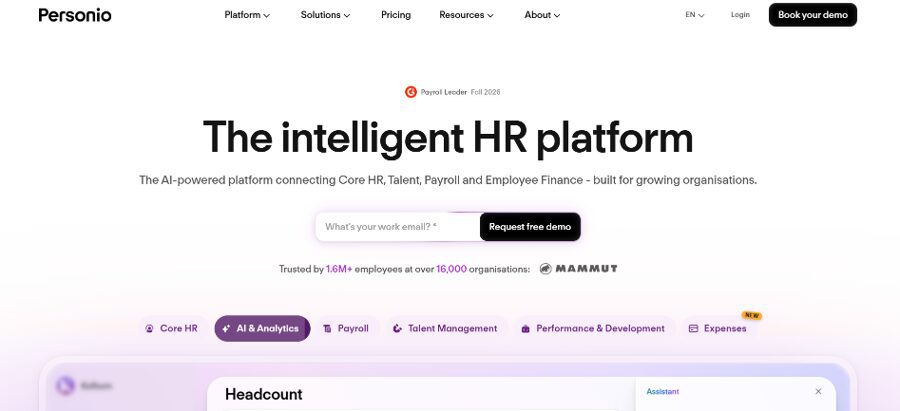
Personio sells core HR with payroll and talent modules around it, and its stated range is 10 employees at the bottom and 10,000 at the top. Its AI is the Personio Assistant, with an employee-facing version, plus AI summaries in performance reviews, and Personio states the AI is secure, controlled and never used to train models. Absence Management and Time Tracking sit in Core HR, and Workforce Planning is listed in both Core and CorePro.
For a UK team the Assistant takes the question side of the Monday list and the review summaries cover the cycle, with a catch. Performance & development is an App, Personio’s word for an extra feature sold to complement Core (the same goes for Surveys, Recruiting and Compensation management), which puts the AI review summary in a paid App. The Core plan handles one legal entity; CorePro lifts that to unlimited. Hosting is European, with Frankfurt one of the named locations.
UK payroll is where Personio’s AI has least to work with. The homepage menu calls the product Payroll Preparation: preliminary payroll generates exports for your payroll accountant or software, a Xero integration sends the data across in one click, and there’s a Sage 50 export. The native, ITSG-certified payroll engine is German, and Personio’s English pages make no HMRC or RTI claim. The entry price, €7.60 per head per month, is the only one published and it’s in euros; a demo sits in front of both Core and CorePro, annual contracts commit you for 12 months, and you pay a setup fee once, bigger for bigger companies. Personio scored 4.4/5 on G2 (1,088 reviews, 26 October 2026).
AI pricing: not stated. Personio’s pricing page lists Core and CorePro behind “Book a demo” and doesn’t place the Assistant in either plan or price it on its own.
Not covered by the AI: the HMRC side of UK pay. Personio’s UK payroll is preparation and export to Xero, Sage 50 or a file for your accountant; the only native pay engine is in Germany.
4. Access PeopleHR
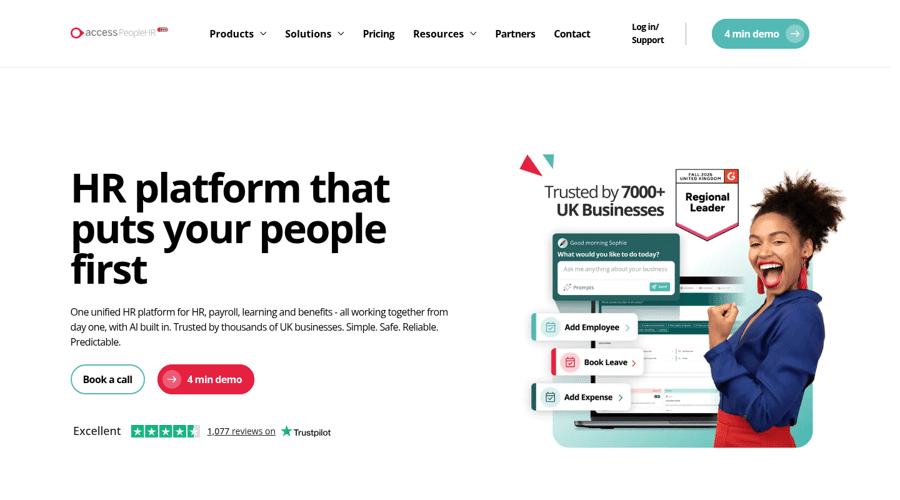
Access PeopleHR, part of The Access Group, is one of the few here to publish UK prices. The HR tiers run Starter £4, Core £6.25, Pro £9.25 and Elite+ £11 per employee per month, with no employee limit. Its AI is branded Evo. The Starter tier lists an AI-powered HR assistant, the same page names Evo Copilot as its Gen AI HR assistant, Evo Payroll Assistant is for payroll users, and Evo Researcher plus agentic workflow automation are for power users on an advanced licence.
On the Monday jobs, the HR assistant handles the question side from the cheapest tier, which is a real point in its favour for a 60-person firm. The payroll questions go to Evo Payroll Assistant, and you only meet it if you buy Access payroll, which is HMRC compliant with pension enrolment and sold as Payroll SaaS from £3 or Payroll Managed from £5 per employee per month, or inside the Full Suite bundles (£7.75, £10.75, £12.50 a head). Performance Management is a £2 add-on, People Analytics Premium £1.50 and Recruitment £1.50. The Core tier is where onboarding and the reward-and-recognition platform start; Pro is where performance management and the survey builder start.
The Employment Rights Act module (£2 per employee per month) needs a plain description, because the name suggests a workflow engine. Access sells under that name a training series of 22 courses (RoSPA-assured, CPD-certified) that sits on the HR data you already hold and gets updated when legislation changes. It will help line managers learn the rules; it calculates nobody’s SSP. Access PeopleHR scored 4.0/5 on G2 (487 reviews, 26 October 2026).
AI pricing: mixed. The HR assistant comes with the Starter tier; Evo Payroll Assistant carries additional variable usage costs for payroll users; Evo Researcher and agentic workflow automation need an advanced user licence.
Not covered by the AI: payroll on the HR-only tiers. The £4 to £11 HR plans don’t include Access payroll, which is a separate Payroll SaaS or Managed line or a Full Suite bundle, so the Evo Payroll Assistant only appears once you’ve bought pay.
5. Employment Hero
Employment Hero‘s HR and payroll products go to organisations between 10 and 2,000 people, and it won’t sell fewer than 10 seats. Its AI is Hero AI, described as an intelligent employment assistant, and the named features cluster around recruiting: an AI-powered Shortlisting Agent, AI screening, AI video interviews and an AI notetaker. On the payroll side there’s an Automated Webchat, an AI-powered chat assistant.
UK statutory work is Employment Hero’s strongest ground, and configured payroll rules do that work while the AI sits elsewhere. The payroll engine is its own, and both HMRC filings (the FPS and the EPS) go out in real time. SSP, SMP, SPP and SAP each have a leave category, the 52-week average is available for holiday pay, the Work Eligibility Report shows each person’s right-to-work position and when their documents run out, and a Probation Report lists who’s on probation and when the review falls. HR Engage carries the Recruitment agent, plus learning and performance management (reviews, feedback, 1:1s). The recruitment AI is also sold on its own: Pro 50 is £99 (conditions apply) for 50 AI video interviews with no HR or payroll subscription.
The price list changes on 1 November 2026 for anyone new, and anyone who signed earlier keeps the previous pricing. HR Essentials is £6 per employee per month, HR Engage £9, HR Elite custom. Payroll runs Free at £0, Core at £4 (minimum £40 a month) and Managed at £14 (minimum £140). Employment-law advice is a separate line at £7 a head monthly (£70 minimum), and HR Elite is where compensation management, goals, workforce planning and 360 reviews live. Employment Hero’s G2 listing is global rather than UK-specific; it scored 4.4/5 there (4,360 reviews, 26 October 2026).
AI pricing: by tier. The Recruitment agent sits inside HR Engage (£9 a head monthly on the post-1 November 2026 list), and the video-interview product is sold alone at £99 for 50 interviews; the pricing page doesn’t say which tier carries Hero AI itself.
Not covered by the AI: the statutory work. SSP, SMP and the 52-week holiday-pay average run as configured payroll rules, and the probation and right-to-work views are standard reports; Employment Hero’s named AI is recruiting and a payroll webchat.
6. BrightHR
Part of Peninsula Group, BrightHR sells HR software with employment-law support wrapped round it, and its pricing page leads with “Created by experts. Powered by AI.” The AI is BRAINBOX+, which BrightHR describes as expert-written answers with AI behind them. In this product it’s the policy-question tool: you ask an employment question and get an expert-written answer surfaced by AI.
Absence management is in every tier, which covers the holiday question as a record, though BrightHR doesn’t describe BRAINBOX+ reading your absence data to answer it. Enhanced, the middle tier, brings in round-the-clock advice on HR and employment law, the employment-law change updates and an optional indemnity policy covering employee claims; the Full tier adds health and safety support and an EAP. Performance management, shifts and rotas and an employee perks marketplace are listed, with BrightLearn as the learning system. No AI task is attached to reviews.
Payroll sits apart from the HR tiers. BrightHR sells its Payroll as software (which, it says, keeps to the statutory rules on pay) or as a managed service whose team runs gross-to-net and handles HMRC for you; either way it needs its own demo, and the online HR tiers list a “Payroll navigator” that the FAQ describes as payroll reporting. Online prices start at £16.67 per employee per month for Core HR at the calculator’s five-employee default (£83.35 a month excluding tax), £21.20 for Enhanced and £31.30 for Full. The FAQ’s own floor is £3.00 per person, which it says depends on business size; insurance is outside the online price; and the contract is a fixed 24, 36 or 60 months, 36 being the online option. BrightHR scored 4.3/5 on G2 (222 reviews, 26 October 2026).
AI pricing: included. BrightHR calls BRAINBOX+ a bonus feature, free to its HR software users from the Connect HR tier.
Not covered by the AI: the pay run. BRAINBOX+ answers employment questions; BrightHR Payroll is a separate software or managed service with its own quote route, and the online HR tiers carry only the Payroll navigator reporting view.
7. CharlieHR
Built for small UK businesses, by its own account, CharlieHR is all-in-one HR software priced per month by headcount band: £21 a month covers 1 to 4 people, the 30-to-49 band is £185, the 50-to-99 band £323, and the top band (250 and over) £754, all excluding VAT. Every plan includes employee records, onboarding, leave management, performance reviews, engagement surveys and perks. Its AI, AskCharlie, isn’t in that list. It sits inside Charlie Grow, the add-on whose main content is unlimited time with CIPD-qualified HR advisors: they review contracts and warn you when new legislation affects a policy.
On the Monday jobs, CharlieHR’s pages place AskCharlie beside the advisors under compliance and policies and don’t itemise what it answers, so the fair reading is a policy-question layer inside a package whose main value is the advisors. Leave, reviews and surveys run in the core product with no AI attached. Data is held on AWS servers in Ireland. There’s no payroll of CharlieHR’s own; the integrations page lists Xero Payroll and PayCaptain.
Charlie Grow costs £200 a month for 1 to 4 people, rising to £1,253 for 250 and over, on top of the core subscription, and Charlie Recruit (from £55 a month) can only be bought alongside a Charlie subscription. For a 50-person company that’s £323 for Charlie plus whatever Grow band applies before AskCharlie appears. CharlieHR scored 4.6/5 on G2 (83 reviews, 26 October 2026).
AI pricing: paid add-on only. AskCharlie comes with Charlie Grow, priced between £200 and £1,253 a month by headcount, on top of the core Charlie plan.
Not covered by the AI: payroll. CharlieHR runs no payroll of its own; pay goes through Xero Payroll or PayCaptain integrations.
8. Workday
Workday HCM is the one enterprise suite among these eight, and its AI is led by Sana, with a set of HR agents and a Workday Payroll Agent alongside, and Skills Cloud uses machine learning. The suite’s five areas are Core HCM, Experience & Engagement, Talent Management, Workforce Planning & Analytics and Workforce Management, with learning and employee-voice tools attached.
On the UK jobs, the payroll check is the most concrete claim: Workday’s payroll page describes an anytime audit that detects anomalies with AI, running on payroll Workday itself operates in the UK, and a compliance dashboard that monitors regulatory changes. Sana takes natural-language questions across the suite. Workday’s UK pages describe Talent Management without attaching an AI summary to the review cycle, and the payroll page carries no HMRC-specific wording, so Workday publishes less UK statutory detail than the smaller vendors here.
Workday’s own payroll engine runs in Australia, Canada, the US, France, Ireland and the UK, and with Workday Payroll provided by Strada the total passes 60 countries; beyond that, Workday lists partners such as Strada, CloudPay, Deel and PwC, which between them extend coverage past 180 countries. Pricing is by quote. Flex credits pay for the AI, which Workday describes as usage-based pricing that aligns to value rather than tokens. Workday HCM scored 4.2/5 on G2 (2,466 reviews, 26 October 2026).
AI pricing: quote-only and metered. The suite is priced by quote, and AI usage draws down Flex credits, so the agents are a usage line on top of the licence.
Not covered by the AI: payroll outside Workday’s own countries. Workday’s native payroll list is the UK and Ireland, plus France, and outside Europe the US, Canada and Australia; other countries run through Strada or partner integrations, so a UK group with staff elsewhere pays them through a connected system.
What to check before you choose AI HR software
Where the assistant reads from
Ask each vendor to show the assistant answering a holiday-balance question for a named employee, then a payslip question for the same person. If the second one fails, the pay data lives somewhere else. HiBob, Employment Hero and Workday run UK payroll inside the product; Access PeopleHR and BrightHR sell it as a separate line; Factorial, Personio and CharlieHR hand the pay run to a connected provider.
Who approves what the AI changes
The useful question is whether the assistant can change a record without a person clicking approve. HiBob says no in writing, with a human required for any action affecting company data and an admin switch to turn AI off. Factorial says One asks before it acts. Personio says its AI is never used to train models. The other five publish less on this, so ask for it in the security questionnaire as well as the demo.
What the AI costs on top of the licence
HiBob and BrightHR include it. CharlieHR sells it only as an add-on. Access PeopleHR and Workday meter or licence-gate parts of it. Factorial and Personio don’t state it, and Employment Hero states it only for the recruitment agent, which in practice makes it a quote question. Put the AI line on the same spreadsheet as the HR and payroll lines, because a cheap HR tier with a metered assistant can end up costing more than a quoted platform that bundles it.
ChatGPT and UK payroll
A general chatbot can explain how SSP works and draft a letter. It can’t see your employees’ earnings or tax codes, and it has no HMRC submission route. Pasting a payslip into it also moves personal data outside your HR system. The vendor assistants above answer from the record under the system’s own permissions. The one documented bridge here is HiBob MCP, which brings governed people data from Bob into ChatGPT, Claude, Copilot and Slack with the same access rules applied.
Which AI HR software fits a UK company in 2026
If you run HR for 50 or more people in the UK and want the Monday inbox handled by the system that holds the record, HiBob is the pick. Bob Companion is part of Bob Core, and the Time Off module works out SSP while the Time Off and Payroll Agents answer the holiday and payslip questions from native HMRC-recognised payroll. The Performance and Surveys Agents cover the review cycle, and a person approves anything the AI would change.
The other seven split on one point. Employment Hero, Access PeopleHR and BrightHR keep their AI away from the pay run or sell payroll as a separate line; Workday bills its agents through Flex credits; Factorial, Personio and CharlieHR prepare UK pay for someone else to run, which limits what their AI can say about it. G2’s 2,711 reviewers (26 October 2026) rated HiBob 4.5/5, and it has 5,500+ customers on its books in 170+ countries.