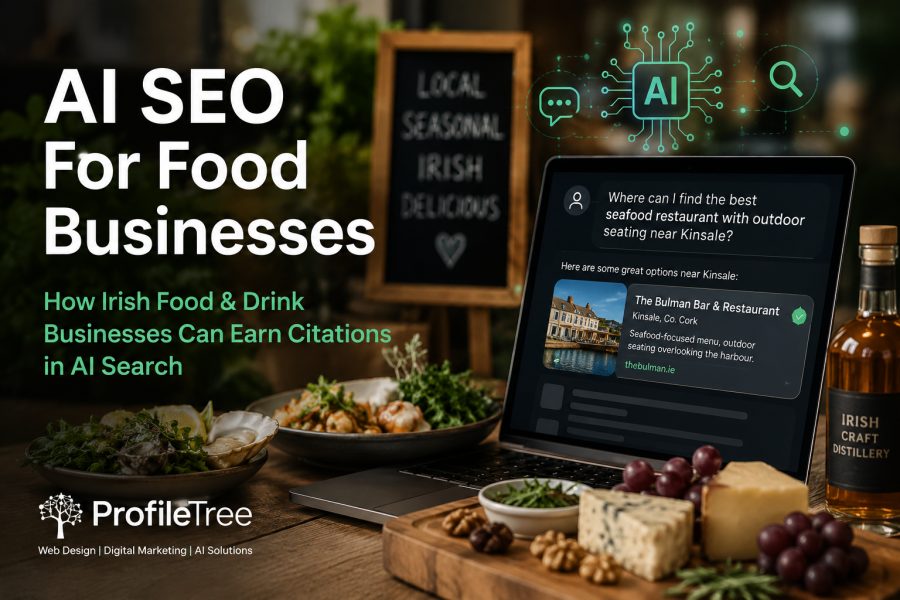
When a diner in Cork asks ChatGPT for “a good seafood restaurant with outdoor seating near Kinsale” or a buyer in Dublin asks Gemini “which Irish whiskey distilleries do private tours under €100 per person,” the answer they get back rarely contains ten links. It contains one or two recommendations, sometimes three. The restaurants, distilleries, food producers, and cafés that get named in those answers are winning the search before the customer has even clicked anything. Everyone else is invisible.
This is the practical shift Irish food and drink businesses are walking into in 2026, and most haven’t adjusted to it yet.
Ciaran Connolly, founder of Belfast-based digital agency ProfileTree, has spent the last eighteen months tracking how AI systems decide which businesses to cite when someone asks a food-related question. “The pattern is consistent across Ireland,” he says. “Producers and operators who built their websites for Google in 2018 are now being skipped over by AI assistants in favour of competitors with weaker SEO but better structured information. The advantage is shifting from authority to clarity.”
That matters for a sector built on small and mid-sized operators. Bord Bia reported in January 2026 that Ireland’s food, drink and horticulture exports reached a record €19 billion in 2025, with the out-of-home foodservice sector across the Republic and Northern Ireland surpassing €9.8 billion in turnover. The sector is enormous. The discovery layer has changed underneath it.
This article covers what’s actually different about AI search for food and drink businesses, what concrete steps move the needle, and where the budget is best spent if you’re a producer, distillery, café, restaurant, or food tourism operator in Ireland.
What AI search is actually doing when someone asks about food
When a user types or speaks a question into ChatGPT, Gemini, Perplexity, or Google’s AI Overviews, the system silently breaks the question into smaller sub-questions. SEO practitioners call this query fan-out. “Best Italian restaurant in Galway for an anniversary” becomes ten or twelve related questions running in parallel: which restaurants in Galway have Italian cuisine, which have private dining, which take reservations, which have recent positive reviews, which mention anniversaries in their content, which are open on Sundays.
The AI then retrieves dozens of URLs across those sub-questions and chooses a handful to cite. Ahrefs published a study in April 2026 analysing 1.4 million ChatGPT prompts. The finding that matters most for food businesses: cited pages had titles and URL slugs whose semantic match to the fan-out questions was measurably higher than non-cited pages. Pages with natural language URL slugs had an 89.78% citation rate. Pages without sat at 81.11%.
In plain terms: the page that gets cited is the one whose title, URL, and opening paragraphs read like a direct answer to a question a real customer would ask. Not a page stuffed with keywords. A page that sounds like it’s answering something.
This changes how food and drink businesses should think about their websites. The menu PDF is invisible. The “About Us” page packed with chef autobiography is mostly invisible. What the AI needs is structured, plain-language answers to specific questions.
Why most Irish food sites are currently failing this test
Walk through twenty Irish restaurant and producer websites and the same patterns appear:
The menu sits in a downloadable PDF, sometimes behind a click-through. AI assistants and Google’s crawlers cannot reliably extract structured data from PDF images. The dish names, ingredients, dietary tags, and prices are effectively hidden from the systems that recommend restaurants.
The opening hours live inside an image or a graphic on the homepage. Same problem. Voice assistants prioritise restaurants whose hours are marked up in machine-readable structured data with holiday exceptions handled correctly.
The location page reads as marketing copy: “nestled in the heart of West Cork, offering an experience like no other.” It does not answer the questions a real diner asks. Where can I park nearby? Do you take walk-ins? What’s the dress code? Is the building accessible? Can the kitchen do dairy-free?
There is no question-answer content anywhere on the site. Yet the searches feeding AI systems are conversational and question-shaped. “What’s a good place for Sunday lunch in Howth with kids?” gets answered by a restaurant that has explicitly written about Sunday lunch in Howth with kids.
The Google Business Profile is half-populated. No menu items uploaded. Categories incomplete. Photos eighteen months old. Q&A section empty. Reviews from 2023.
None of this is a content marketing failure in the traditional sense. The website may rank perfectly well for the brand name. The problem is structural. The information is there, just in a format that AI systems cannot read or trust.
The four things to fix first, in order
There are dozens of small optimisations that move AI citation rates. For an independent Irish food or drink business with limited time and budget, four interventions deliver the bulk of the gain.
One: Put your menu in HTML, not a PDF. Every item, every price, every dietary tag, every allergen note as readable text on a page. This single change opens the door to dozens of specific dish queries that PDF menus block. A diner asking ChatGPT “where can I get a properly aged sirloin in Dublin 2” can only be matched against restaurants whose menus exist as machine-readable text.
Two: Add a question-format FAQ section to your highest-traffic pages. Not the generic “do you take bookings” filler. Real questions, in the language customers use: “Do you have a private dining room for a 30th birthday?” “Can I bring a corkage bottle?” “Are dogs allowed in the beer garden?” “Do you cater for coeliac diets?” The questions you get asked by phone every week. Write the answers in two to three sentences. AI systems extract these answer blocks directly into responses.
Three: Fully populate your Google Business Profile and treat it as a living asset. Categories correct and complete. Menu uploaded with item-level descriptions. Photos refreshed monthly with seasonal dishes and interior shots. Q&A section actively managed. Every review responded to, not just the positive ones. Across Bloom Intelligence’s platform network, nearly 90% of all guest reviews are 4 or 5 stars. That is a signal pool most operators leave unused.
Four: Implement Restaurant schema markup on your website. This is the technical bit and the one most often skipped. Restaurant or LocalBusiness schema, Menu schema with item-level data, AggregateRating, OpeningHoursSpecification with holiday exceptions, GeoCoordinates, and FAQPage schema on your question-format pages. Schema markup tells search engines and AI systems what your content means, not just what it says. Without it, you’re asking the algorithm to guess. This is where having a good AI-enhanced digital marketing partner pays back quickly, because the cost of doing it once correctly is far lower than the cost of doing it wrong four times.
These four are mutually reinforcing. The HTML menu feeds the schema markup. The schema markup feeds the AI assistant. The Google Business Profile cross-validates against the website. The FAQ content answers the fan-out queries. Done together, they compound.
Where Irish operators have an unusual advantage
There’s a quieter point worth raising. Most of the content currently feeding AI assistants for “best restaurant in Cork” or “Irish whiskey distillery tours” was written by aggregators, listicle sites, and food bloggers, not by the businesses themselves. The first-party content gap is enormous.
A small distillery in Kerry that publishes a genuinely good answer to “what’s the difference between single pot still and single malt Irish whiskey, and which should I try first” can outrank Wikipedia for that fan-out query within months. A café in Sligo that publishes a clear page on “Sligo brunch spots with sea views” will be cited by AI systems trying to answer that exact question, because no one else has written it from a first-party perspective.
The same applies to producers. Irish cheesemakers, charcuterie producers, craft brewers, and small-batch food brands rarely publish their own substantive content about pairings, provenance, production methods, or how their products compare across categories. Those gaps are where AI citations are won. The wholesale buyer asking Gemini “which Irish farmhouse cheesemakers produce raw milk cheese, and where can I order direct” is being answered by whoever has written that page. Usually no one has.
What this means for your reviews and your reputation work
A consistent finding across recent AI search studies is that AI systems cross-reference website content against third-party signals before recommending anything. A beautiful website on its own is no longer enough. The reviews, citations on directory sites, local press coverage, food blog mentions, and Instagram presence all feed into the AI’s confidence that you’re a real, trusted business.
For Irish food and drink businesses specifically, this means three practical actions. Encourage every happy customer to leave a Google review (the easiest moment is at the till or after the bill, not a week later). Build relationships with Irish food publications, food bloggers, and regional press. List your business correctly on every relevant directory: TripAdvisor, OpenTable, Yelp Ireland, Trustpilot if relevant, your local tourism board’s website, Bord Bia’s producer directories if you’re a producer.
Each of those is a verified entity citation. AI assistants triangulate across them. A restaurant that exists only on its own website, with no third-party validation, looks thin. A restaurant that appears consistently across ten different trusted sources looks real, and gets recommended.
A practical 90-day plan
If you’re an Irish food or drink business reading this and wondering where to start, here’s a sequence that works without overwhelming a small team.
Weeks one to three: get the menu out of the PDF and onto the website in HTML. Add prices, descriptions, allergens, dietary tags. Audit your Google Business Profile. Fill in every missing field. Upload twenty fresh photos.
Weeks four to six: write twelve to fifteen FAQ items that answer the questions your customers actually ask. Add them to your most relevant pages (private dining FAQ on the events page, allergy and dietary FAQ on the menu page). Brief a developer on adding Restaurant schema, Menu schema, and FAQPage schema. Aim to have it implemented by week eight.
Weeks seven to nine: review every directory listing you can find. Fix any inconsistent name, address, or phone number entries. Set up a simple process for asking happy customers for reviews.
Weeks ten to thirteen: write three substantive blog posts that answer specific question-shaped queries in your area or category. Not “5 reasons to visit our restaurant.” Real questions, written from your first-party expertise.
By the end of ninety days, your business will be visible in AI search in a way it wasn’t on day one. None of it requires advertising spend. All of it compounds.
The window is now
The reason this matters so much in 2026 is that AI search is still being trained on the content that exists today. The businesses that publish clear, structured, useful content this year are building the entity associations that AI systems will rely on for years. The ones who wait will spend the next decade trying to overtake competitors who got there first.
Ireland’s food and drink sector has the products, the stories, and the reputation. What it largely doesn’t yet have is the digital infrastructure to make sure AI assistants recommend Irish businesses when someone asks. Closing that gap is one of the highest-leverage moves an independent operator can make right now, and it costs a fraction of what most marketing investments do.
About the author
Ciaran Connolly is the founder of ProfileTree, a Belfast-based web design, SEO and digital marketing agency. Since 2011, the team has completed over 1,000 web projects for businesses across Northern Ireland, Ireland, and the UK, and holds a 5-star Google rating from more than 450 reviews. Ciaran also delivers AI training for SMEs through Future Business Academy and works regularly with food, hospitality, and producer brands on digital strategy.