Oysters occupy a strange position in the seafood world. They’re a delicacy, often the most expensive thing on the menu, and yet they’re also one of the few things in the sea you can eat with a genuinely clear conscience.
Most fish farming carries an environmental cost: feed, antibiotics, escapes, waste plumes. Wild fisheries face overfishing and bycatch. Oyster farming, by comparison, looks almost too good to be true. Oysters need no feed, no antibiotics, no pesticides. They clean the water they grow in. They sequester carbon into their shells. They build reefs that shelter other marine life.
This is a clear-eyed look at how oyster farming actually works, what makes it different, and why oysters increasingly appear on lists of the world’s most sustainable foods, drawing on practice at working oyster farms.
If you want to see a real oyster farm in action, Carlingford Oyster Company’s video on oyster farming shows the full process on Carlingford Lough in County Louth, Ireland.
What oysters actually need to grow
An oyster needs three things: clean water, the right temperature range, and food in the form of microscopic algae and plankton. That’s it. No grain pellets, no fishmeal, no chemicals.
This is the bit that makes oysters fundamentally different from finfish aquaculture. A salmon farm has to bring food in from outside the system, often in the form of wild-caught smaller fish, which is part of why farmed salmon has a contested environmental record. An oyster farm extracts food from the water that’s already there.
The oysters themselves are seeded as tiny “spat” (juvenile oysters) and placed on the seabed or into mesh bags on trestles, depending on the growing method. Then the farmer waits. A Pacific oyster typically takes around three years to reach market size in cool Atlantic waters. Native European oysters take longer.
During those three years, each oyster filters around 55 litres of seawater per day. That number is worth pausing on. Over a three-year grow-out, a single oyster will have processed more than 60,000 litres of water.
The filter-feeding effect on water quality
Oysters are filter feeders. They draw water in across their gills, extract the algae and organic matter they need, and release the water back out. In doing so, they remove suspended sediment, excess nitrogen, and phytoplankton, which improves water clarity and reduces the likelihood of algal blooms.
In areas where oyster populations have collapsed (Chesapeake Bay in the US is the most-studied example), water quality has measurably declined. In areas where oysters are reintroduced, water clarity improves and other species return.
This means oyster farms aren’t just neutral. They’re actively improving the water they sit in. A working oyster farm is, in ecological terms, a water treatment plant that also produces food.
Carbon, shells, and habitat
Oyster shells are largely calcium carbonate. Producing the shell takes carbon out of the surrounding water. There’s active scientific debate about the net carbon balance of shellfish farming (because the chemistry releases some CO2 as well), but compared with terrestrial protein sources, oyster farming has a very low carbon footprint per kilogram of protein produced.
The shells themselves serve other purposes. Empty shells are increasingly returned to the water to create reef substrate for new spat to settle on, rebuilding habitat that human activity has often destroyed. Oyster reefs reduce coastal erosion, provide nursery grounds for crabs, fish and other shellfish, and stabilise sediment.
A well-managed oyster farm is, in functional terms, an artificial reef that produces food.
Water quality classification: why where matters
Because oysters concentrate everything they filter, the water they grow in matters enormously. This isn’t a marketing concern; it’s a regulatory one.
The European Union classifies shellfish-producing waters into grades A, B and C, based on bacterial counts. Class A water is the highest grade and means oysters can be eaten directly from the harvest area without further processing. Class B and C waters require purification (depuration) in tanks before the shellfish can be sold for raw consumption.
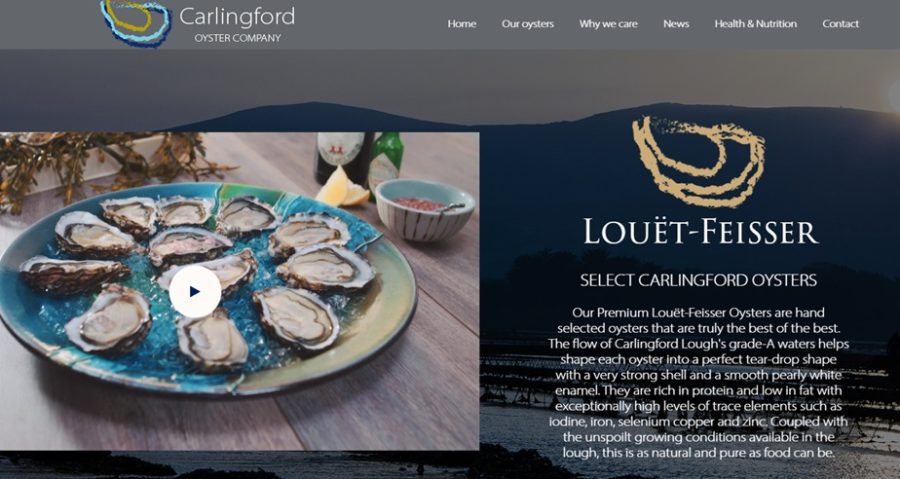
Carlingford Lough on the east coast of Ireland, where Carlingford Oyster Company has farmed since 1974, is Class A. The lough has a strong tidal exchange that brings fresh ocean water in twice a day, and receives mineral-rich freshwater run-off from the Cooley Mountains to the south and the Mourne Mountains to the north. That combination is part of why Carlingford Oysters have a distinctive sweet, slightly nutty flavour.
Even with Class A classification, responsible producers add a purification cycle anyway, with pre-dispatch testing for E. coli, norovirus, biotoxins and salmonella. Sampling is carried out by national agencies (in Ireland, the Sea Fisheries Protection Authority and the Food Safety Authority of Ireland). Every shipment is batch-coded for traceability.
Slow craft and the case for small producers
One of the things that makes oyster farming distinctive is how slow it is. Three years per generation. Decisions made today shape what’s available to eat in 2029. There’s no shortcut, no growth hormone, no industrial intensification that meaningfully shifts that timeline.
This is part of why the best oyster farms tend to be family-run rather than corporate. The Louët-Feisser family at Carlingford Oyster Company is in its third generation on the same lough, having started in 1974 when founder Peter Louët-Feisser began farming oysters after hearing a BBC Radio 4 broadcast on the subject. The farm is now run by his son Kian and Kian’s wife Mary.
That long horizon also means new products from established farms move slowly and carry decades of accumulated craft. A clear example is Alanna, a new cocktail-size oyster launched by Carlingford Oyster Company in April 2026 and named after Kian and Mary’s eldest daughter. Kian Louët-Feisser describes the technical challenge of the smaller format this way:
“It’s actually quite a challenge to grow a smaller oyster that has the full balanced flavour of bigger more mature oysters, but I think after 50+ years we’ve finally cracked it.”
Fifty years of refining the same craft on the same lough is the kind of timescale that simply doesn’t exist in most modern food production. It also explains why farms like this carry the awards they do. The Louët-Feisser premium oyster has won 3-star Great Taste Awards in five separate years (2018, 2020, 2021, 2024 and 2025), the Great Taste Golden Fork in 2021, gold at the 2015 Cloudy Bay British Oyster Championships, and gold, silver and bronze at the Blas na hÉireann Irish Food Awards over the years. Those awards are won by people, not by industrial systems.
Why oyster farming scores well on sustainability rankings
When organisations like the Marine Conservation Society or Seafood Watch grade seafood for sustainability, farmed bivalve molluscs (oysters, mussels, clams) consistently sit at the top. The reasons stack up:
- No external feed inputs. Removes the wild-fish pressure that affects salmon and other farmed species.
- No antibiotics, hormones, or pesticides. The animals don’t need them.
- Net positive water quality impact. Filter feeding improves the surrounding ecosystem rather than degrading it.
- Low energy footprint. Compared with land-based protein, oysters require very little energy to produce per gram of protein.
- Habitat creation. Trestles and reefs become refuges for crabs, juvenile fish, and other shellfish.
- Slow growth, traditional methods. Three years on the seabed isn’t industrial-scale intensification.
The trade-offs are real but limited. Oyster farms occupy space in inshore waters that other users (recreational boating, wild fisheries, conservation interests) also want. Plastic gear (mesh bags, trestles) can shed microplastics if not managed well. And ocean acidification, driven by climate change, is the long-term threat to all shell-forming species, oysters included.
What this means for the people eating them
For anyone trying to eat more sustainably without giving up animal protein altogether, oysters are one of the clearest wins available. They’re high in protein, rich in zinc, iron, selenium, copper and iodine, low in fat, and produced in a way that improves rather than damages the marine environment.
The food miles are usually short, particularly in Ireland and the UK, where there’s a working oyster industry on both coasts. The producers tend to be small, family-run operations rather than industrial concerns. The skills involved are traditional and labour-intensive.
If you want to see what that actually looks like (trestles in the water, oysters being graded by hand, the daily rhythm of tide and weather that governs the work) it’s worth watching how a family-run Irish oyster farm operates day to day at Carlingford Oyster Company. They’ll also be sampling oysters from their full range, including the new Alanna, at Bloom in the Phoenix Park, Dublin, from 28 May to 1 June 2026.
The bigger picture
The world has spent the last fifty years industrialising food production at a scale and pace that’s already brushing against ecological limits. Oyster farming, by contrast, looks almost old-fashioned. Slow, manual, dependent on clean water and patient farmers, and giving more back to the environment than it takes.
That’s not a marketing position. It’s just what oyster farming is.