London, as the capital and largest city of the UK, has a population of just over 7,500,000. Despite the parks, trees on city streets, and the paid entry of cars into the centre, this city cannot boast of particularly good ecology. Therefore, Londoners are constantly trying to come up with ways to improve the environmental situation, and they pay a lot of attention to the problem of household waste.
There are several official specialised waste collection companies in London — for example, anylondonwaste.co.uk. In this article, we’ll tell you what effective methods Londoners use to make their city cleaner and how the government is planning to clean up the streets.
How Is Waste Sorting Going?
The main role in sorting waste is played by citizens: it has long been customary in the city to put different types of rubbish in different containers. Private homeowners are required to sort their waste like this:
- A container with a blue coloured logo is usually intended for newspapers, magazines, paper, and cardboard;
- A container with a green logo is used to collect glass bottles and cans, just don’t forget that the lids from them should be thrown out separately;
- A red container is provided for plastic and tin waste, with the exception of foil; dustbins are marked in grey.
The duty to sort garbage in London is also supported by law (the penalty for violation is up to £1,000).
The London authorities pay a lot of attention to the environmental education of the population. However, the townspeople themselves are interested in ecology. Almost every week in London there are new programmes connected with ecology. Including programmes about waste disposal.
London Local Government and Recycling
Recycling is most effective when items are reused in the house rather than thrown away. Other approaches include transferring glass objects to supermarket bottle jars and composting biodegradable waste, making its disposal unnecessary.
According to the latest data:
- 44.3% of household waste was recycled in 2021.
- In the period from 2000/01 to 2009/10, the volume of recycling of household waste in England increased by 235%.
- In 2021, 26.7 million tons of household waste were generated, ~ 11.6 million tons of which were reused or recycled into compost.
- In 2021, dry recycling was the largest component of recycled waste, accounting for 59% of the total.
The problem with waste management and waste disposal is acute in London — the capital produces 17 million tons of waste annually, and the forecast says it’ll increase to 26.5 million tons in 2022.
How Is Rubbish Recycled Nowadays?
London is a big city, so recycling is quite well established there. Almost everything is recycled — paper, metal, glass, plastic, and even batteries. Newspapers, magazines, plastic and glass bottles, and tin cans can be placed in special containers too. Further, the path, for example, of an abandoned bottle, which is subject to further recycling, lies at a special sorting station.
Initially, you sort everything yourself, but not everyone’s able to separate the dense metal layer from a layer of cardboard (juice packaging) or, for example, understand how to properly dispose of things containing both plastic and metal. Therefore, the garbage is sorted again. Only then is it sent to the processing plant, from where it leaves in the form of new materials.
You can buy the result of all this activity in a regular store —looking at a pack of cottage cheese or a box of cookies; you may find an icon saying that this pack or box was made from recycled raw materials.
Since waste is divided into several categories according to its characteristics, it’s better to disassemble each type separately. That’s what we’ve done below!
Metal
Every year, UK residents use 12 billion metal cans. Many waste management companies recycle them and other metal items within 60 days of collection. This is a closed cycle: after sorting, the containers are compressed and passed through a press, and later new cans are created from them for food producers.
Glass
Glass recycling is a little more complicated. First, it’s sorted by colour and cleaned of impurities, then crushed and melted, new bottles and cans are then cast, and new containers are sent to enterprises. Part of the glass goes to the production of bricks, fibreglass and decorative products.
Plastic
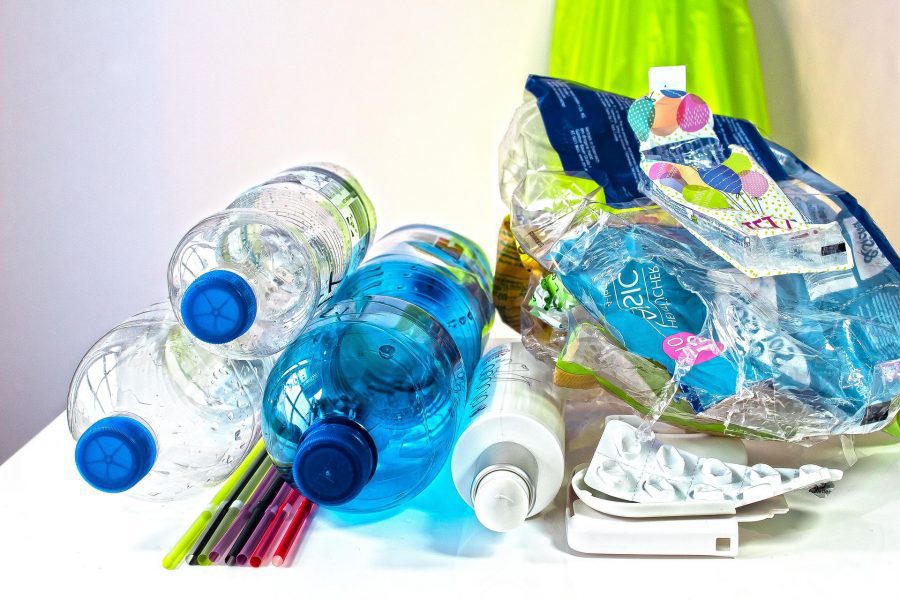
In 2020, a plastic recycling plant was opened in Northern England. The technology used at the enterprise allows people to create high-quality plastic pellets. New containers are made from them. And the Scottish company MacRebur has developed a technology with which such pellets are used when laying asphalt.
Plastic bottles have also been used to sew clothes in Britain for a long time, including uniforms for school students.
Paper
At processing plants, paper is sorted into several categories: newspapers, packaging, dirty paper, copy paper, etc. Further, the paper that can be recycled is crushed, cleaned, and passed through filters to get rid of unnecessary parts (paper clips, etc.), and ink is also removed from it. Then the resulting mass is made denser, clarified, dried, and wood fibres are added. The material passes through the press and is dried again. After this, the paper is ready for reuse.