
The pandemic has caused an increase in the shift from offline stores to online stores. Unfortunately, as ecommerce trade increases, online businesses are at risk of fraudulent activities now more than ever.
Fraudsters and scammers gain easy access to the company’s sensitive information and customers’ sensitive data to carry out their fraudulent activities, putting businesses at risk of data breaches, chargebacks, and loss of trust from their most valued clients.
Statistics show a 70% increase in online fraud due to the pandemic, and the number keeps growing.
In this article, you will discover the three most effective ways to protect your ecommerce business from online fraudsters. Keep reading to find what they are. But first, let’s start with the definition of what ecommerce fraud prevention is.
What is ecommerce fraud prevention?
Ecommerce fraud prevention is simply blocking the different ways fraudsters can intrude on your transactions as an online business. This includes adopting the right tools and following required procedures to monitor your online business transactions from cyber threats.
Ecommerce fraud detection techniques are a must-have for every business that wants to manage risks, decrease frauds, and stay in operation.
The first step to mitigating the intrusion and impact of ecommerce fraud is for businesses to be aware of the different types of online fraud. This way, they can follow preventive procedures so they do not put their businesses at risk.
Common ecommerce fraud trends in 2021
There are many ecommerce fraud trends; but, in this article, we will discuss the commonest trends you need to look out for as an ecommerce business. Let’s discuss them below:
Chargeback or friendly frauds
Chargeback or friendly frauds are also called reversal funds. It occurs when the funds used to purchase are returned to the buyers for different reasons. One reason could be that the buyer didn’t receive the item. It could also be that the buyer made a purchase mistakenly or made the payment twice.
Although chargebacks were invented to protect customers’ interests, they are now often used as fraudulent acts by scammers and dissatisfied customers.
For example, clients can request chargebacks because they changed their minds after making a purchase or because your business’s policy doesn’t work in their favor.
Also, a company can request a chargeback on the grounds of never receiving their purchase, although they already have the item in their custody.
The fact that some customers use the chargeback privileges for fraudulent activities is why you should protect yourself as a business.
To do this, you should have a strict refund policy. This way, the request for chargebacks can be closely monitored and mitigated.
Triangulation fraud
Triangulation fraud occurs when a fraudster opens a fake store online. The store offers products at highly competitive prices actual stores can’t compete with to attract many customers.
When a customer places an order on this fake store, the fraudster requests the customer’s bank details and uses these details to purchase the products the customer requested from an actual store online.
The customer, therefore, pays for the product twice. And because the customer receives the products from the fraudster, the online store appears legitimate while the real online store appears to be a scam. In the end, it is the authentic online business that makes the refund.
To control triangulation fraud, lookout for customers who make repeat orders of the same products with different shipping addresses for every order they make.
Telephone fraud
Telephone fraud, also known as communication fraud, is a fraudulent activity used by scammers on your customers.
It’s when scammers use telecommunication services to obtain funds from your customers illegally.
For example, the fraudster pretends to be an authority or someone who is trying to help. In the process, they convince your customers to pay for the products they need at really ridiculous prices.
The scammer may also offer them a free trial for some products and services you offer.
In the process, they use your customers’ details to sign them up for products and services that don’t exist, thereby carting away a huge sum of your customers’ money monthly.
Telephone fraud should be taken seriously to avoid loss of clients, chargebacks, and negative brand image.
Therefore, when your clients report that a party is trying to scam them using your company’s name, you should take quick, actionable steps to protect your customers from an intending telephone fraud.
One of the first steps you can take to mitigate telephone fraud is to go public with the occurrence. You should announce the telephone fraud on social media or blogs and make it known that your company isn’t behind such schemes.
By doing this, you can maintain a good brand reputation and save the rest of your customers from falling prey to fraudsters.
Another preventive measure to take is to report the telephone fraud to appropriate authorities.
Authorities such as service providers and law enforcement agencies can work efficiently to fish out the fraudsters and make them known to the public. With this, your customers can be adequately safeguarded from such fraud.
3 proven ways to prevent ecommerce fraud for your business
The best way to prevent ecommerce fraud for your business is to put necessary precautions in place.
Below are the top three ecommerce fraud preventive trends you can adopt to protect your ecommerce business
Perform frequent site security audits

An effective way to detect lapses in your security system is to perform frequent site security audits. By doing this, you will discover security loopholes and fix them before fraudsters and scammers do.
A good site security audit ensures that the communication lines between you and your customers are well encrypted to prevent hackers and fraudsters from sensitive data.
To do this, use Hypertext Transfer Protocol Secure (HTTPS). HTTPS’s role is to ensure that your customers’ data is well secured. Details such as your customers’ names, credit card numbers, and addresses are encrypted with HTTPS, so fraudsters do not have access to them.
It ensures your website is adequately and frequently scanned for malware and provides a good backup frequency for your ecommerce business.
What’s more? Running a frequent site security audit ensures your hosting dashboards passwords, CMS, and database are strong enough to prevent hackers’ intrusion. It identifies active and inactive plugins to take necessary action against the inactive plugins.
By putting all these steps in place, your ecommerce business will be adequately prepared to prevent fraudsters from hacking into your transactions.
Place restrictions on activities

One of the most effective mitigating measures for ecommerce fraud is placing restrictions on how you request your customers’ sensitive information. Another way is to limit the number of purchases you accept per day.
By reducing the amount of sensitive information you request from your customers to the basics, you reduce the number of sensitive data fraudsters can access.
Therefore, it’s helpful to only request the information you need to complete a transaction. Other unnecessary sensitive data should be left out for security purposes.
Another preventive measure you can take is restricting how much sales you accept in a day. When you reduce your daily commercial transactions, you will gain better control of your transactions and keep fraudulent activities at a minimum.
Employ anti-fraud tools
There are several software anti-fraud solutions you can adopt to protect your ecommerce business from fraudulent attacks. They include elementary anti-fraud tools, mid-level anti-fraud tools, and top-level anti-fraud tools.
Elementary anti-fraud tools are connected to ecommerce platforms to identify fraudulent activities through IP addresses, email addresses, and lots more.
Mid-level anti-fraud tools come with a wide range of solutions for your ecommerce business. Some of the solutions they offer include declining suspicious transactions, chargeback guarantees, account security, and many more.
The highest anti-fraud tools provide all the elementary anti-fraud tools, and mid-level anti-fraud tools offer additional features. These solutions include policy abuse protection, review of transactions that are flagged as suspicious, loyalty fraud management, and more.
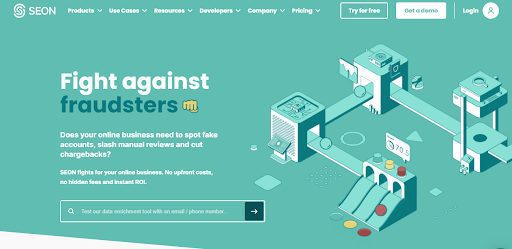
One of the best tools you can employ to secure your ecommerce store is SEON. SEON is an anti-fraud solution for ecommerce that helps you mitigate chargebacks and loss of your company’s data.
With SEON, you can secure your login authentication, automatically review your transactions and reduce your friendly fraud costs.
Other anti-fraud solutions you can introduce to tighten up your ecommerce security include two-factor authentication, Address Verification Service Tools (AVS), and Payment Card Industry Standard (PIC Compliance).
Popular ecommerce fraud signs to look out for
As an online business, it’s crucial to always be alert to discover any impending fraudulent activity that may impede your business transactions.
But how do you know if a transaction is fraudulent? The best way to identify fraudulent activities is to be on the lookout for common red flags.
They include:
- Buyers making multiple purchases at a short time duration,
- Customers using multiple cards on just one IP address, and
- Differences between shipping and billing addresses
Identifying these red flags will help you investigate any suspicious activity to know if any fraudulent activity occurs.
Conclusion
Understanding popular ecommerce fraud trends and the different ways to prevent them from taking place is an excellent way to deal with the increasing fraudulent ecommerce activities.
We, therefore, recommend that you adopt the different ecommerce fraud preventive measures discussed in this article to adequately safeguard your business from these frauds.