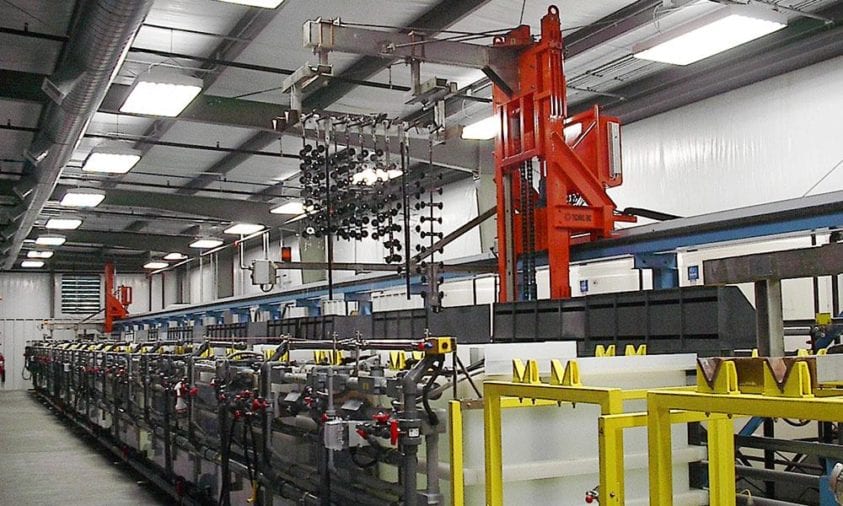
So you may have heard of the phrase, Anodizing. Well, this post explains what it is and how the process works. If your business is within the manufacturing space than this may be of interest to you. Anodizing can be used for car parts, food preparation equipment, jewellery and even in furniture.
One of the best ways to add strength and corrosion-resistance to aluminium is with a process called anodising. Aluminium is already very strong and able to naturally resist these problems much longer than other metals but there is a risk over time that it deteriorates. By anodising the metal, you can further length its lifespan. But how is the process carried out?
What is anodising?
Anodising is an electrolytic passivation process that creates a natural oxide layer on a metal that thickens and protects it. Aluminium is the most common metal to receive this treatment but others that can be anodised include zinc, titanium and magnesium.
Anodising helps to increase resistance to corrosion and wear resistance while also reducing friction and increasing lubricity. It also makes the metal easier to have paints and glues added to it or can be dyed to create coloured coatings. There is a range of finishes available including gloss finishes and colour-fast coatings.
What is the anodising process?
The process gets its name because the part receiving the treatment becomes an anode in an electrical circuit. It is immersed in a bath that contains an acid electrolyte and a cathode. The metal that is going to be coated then becomes the anode and an electric current is passed through the whole bath.
This creates an oxide layer on the surface of the anode due to oxygen ions in the acid. It also means the process is a controlled one and different thicknesses can be created which are measured in microns.
Anodising can be done in batch or continuous modes. The latter is often used for things like coiled materials that need a longer time to coat.
The five-step process
The basic anodising process takes place across five steps. These may vary depending on factors such as the finish or type of part, but the core process is almost always the same. The five steps are:
- Cleaning – this is where acid or alkaline cleaners are used to remove dirt and grease from the part
- Pre-treatment – if there is the requirement for imperfections to be handled then sodium hydroxide can be used for this. Or if something like a high gloss finish is required, then different acids are used to treat the part to help create this
- Anodising – the part enters the bath and the electric current is then passed through it as described above to create the oxide layer
- Colouring – this can be done in a number of ways including electrolytic colouring, integral colouring, interference colouring or even with organic dyeing and will be done at this point in the process
- Sealing – any pores in the oxide layer are sealed to prevent any weaknesses in the part as well as to prevent colour degradation
When the anodising process is complete, the part will have been changed from its original state. Anodic coatings are generally stronger than those without the finish as well as being less likely to crack or to come to lose from any substrate they are bonded with.
What is anodising used for?
There are many applications for anodising in different industries. For example, in architecture, the process is often used on things such as storefronts, curtain walls, stair treads, window extrusions and even balustrades to increase their resistance to wear.
The process can also be used in things as diverse as in jewellery and even in furniture. It is common to see anodised aluminium in marine craft such as yacht masts and pontoons and in many kinds of scientific equipment, where the extra resistance to wear and tear expands the lifespan significantly.