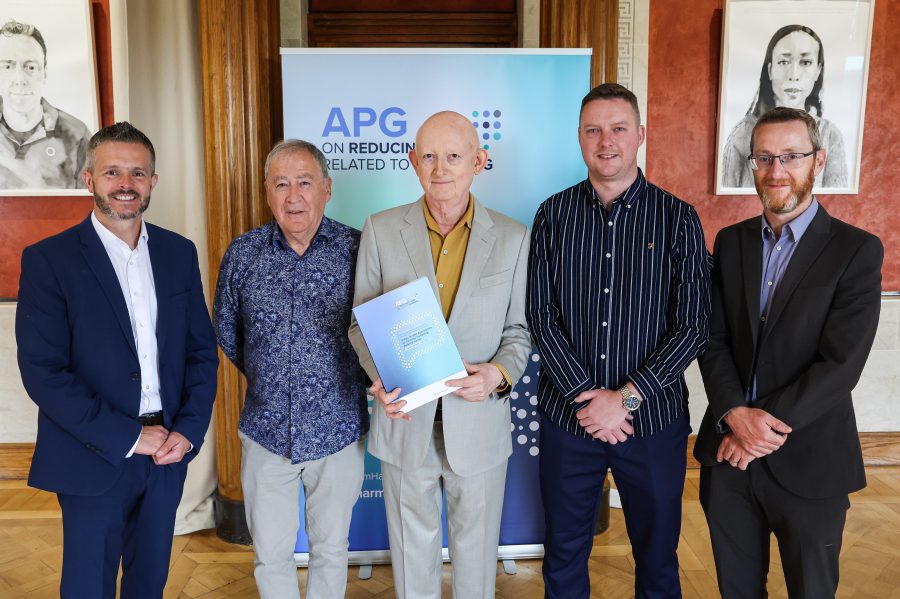
An All Party Group (APG) formed in 2020 on Reducing Harm Related to Gambling has launched a report with almost 60 recommendations from the findings of a year long inquiry into public health approaches to tackling gambling related harms in Northern Ireland.
The report, Public Health Approaches to Tackling Gambling Related Harms, includes evidence presented to the inquiry from the Royal College of Psychiatrists, the British Psychology Society, numerous charities, those with lived experience and many more, indicating a strong connection between gambling and a host of mental and physical health issues. These include low self-esteem, stress-related disorders, anxiety, depression, poor or irregular sleep and appetite, substance misuse, self-harm and suicidality (risk of suicide).
Results suggest that between 130,000 and 200,000 people are indirectly affected each year by gambling harm in NI. This includes not only immediate family members and friends, but also broader familial, social, and community networks, all of whom can suffer profound challenges and distress due to gambling related harm. As many of the submissions to the inquiry argued, it is in large part because of this “ripple effect” nature of gambling related harms that population-based public health approaches prioritising harm prevention are needed, in line with those adopted for alcohol and tobacco.
Speaking about the inquiry conducted by the APG and the recommendations being presented in the report, APG on Reducing Harm Related to Gambling Chair Philip McGuigan MLA said: “The culmination of the findings from the inquiry which have been published in this report cover a wide range of issues, including the impact of gambling on individual and public health in the North, the impact on children and young people, as well as effective approaches to regulation from a public health perspective.
“The overwhelming weight of evidence which the APG received during this inquiry shows that gambling is a significant public health issue here, and we are therefore calling for a public health approach.
“As we proceed towards the next stage of gambling reform, a process which is likely to entail one of the largest – if not the largest – bills ever to pass through the Assembly, several important policy considerations are offered. Chief among these is a “prevention-first” approach which seeks to tackle the root causes of gambling harm first and foremost. Similar to that used for alcohol and tobacco as, with these other legal addictive products, the whole population is vulnerable to gambling addiction and harm.
“The APG is therefore calling on the NI Executive and Departments to take decisive action in adopting these measures.”
Echoing the call for gambling to be recognised as a public health issue, Vice Chair of the APG on Reducing Harm Related to Gambling, Robbie Butler MLA, said: “By recognising gambling as a public health issue and implementing this report’s recommendations from the recently completed APG inquiry, we can set a precedent for effectively ensuring that the long-term wellbeing of individuals and communities, especially children and young people, is safeguarded.
“The findings of this inquiry come at a critical juncture for NI and gambling reform. As noted in the report, we are lagging behind neighbouring jurisdictions in this regard – we remain a “Wild West”, where totally unregulated online gambling operators target our local communities.”
As the APG has previously argued, regulation should be proportionate to risk: highly addictive products, such as electronic gaming machines and online gambling (the latter of which is currently unregulated in NI) should be subject to comparatively more stringent rules. This is all the more urgent as children and young people in NI who engage in gambling are more likely to do so with these much riskier forms.
All the recommendations can be found in the report and include the key areas of the prevalence of gambling related harms in Northern Ireland; evidence of gambling-related harm including its impact on health and financial impact; educating children and young people in schools on dangers of gambling; gambling and video games; inequality of gambling-related harms; gendered aspects of gambling-related harms; provision of treatment in Northern Ireland; regulating for gambling as a public health issue; a commercial determinants of health framework; the appointment of an independent regulator and ombudsman; levy on gambling operators; a mandate for policy coherence; advertising and promotion of gambling; regulating gambling products – availability and accessibility of gambling products, exclusion schemes and blocking software; affordability; licensing of gambling operators and characteristics of gambling products.
The report has been welcomed by Health Minister Mike Nesbitt MLA. He said: “I am very much aware of the public health issues which problem gambling and gambling addiction can create. My Department continues to explore ways to gather much-needed data and evidence which can inform future policy in this area.
“Today’s launch of the inquiry report is an important step forward. My Department and I remain committed to reducing harm related to problem gambling and gambling addiction in Northern Ireland and will work collaboratively with the All-Party Group in any way we can to progress this. We will now take the necessary time to consider the recommendations contained within this important report.”
Department for Communities Minister Gordon Lyons MLA said: I welcome the opportunity to consider the findings of the inquiry which are being presented in this report. I am grateful to the All Party Group for their dedication to highlighting the need to protect our people from gambling harms. I am committed to working with my Ministerial colleagues to find an agreed way forward on these important issues.”
Current gaming and gambling laws here are covered under The Betting, Gaming, Lotteries and Amusements (NI) Order 1985 and the Betting, Gaming, Lotteries and Amusements (Amendment) Act (NI) 2022. Unlike GB, we do not have an independent gambling regulator.