Working at height is a critical part of many industries, from construction and infrastructure maintenance to industrial inspections and façade cleaning, and it always comes with a trade-off between reach, mobility and ground conditions. Choosing the right equipment can mean the difference between a smooth, efficient operation and unnecessary delays, costs or safety risks for your business.
Two of the most widely used solutions on UK sites are crane baskets (also known as personnel baskets or man baskets) and Mobile Elevating Work Platforms (MEWPs). Both lift operators safely off the ground, but they’re built for different jobs, and choosing the wrong one can slow down a project or create unnecessary risk. This guide breaks down the key differences between the two, helping you make the right choice for each specific job requirement
What is a crane basket?
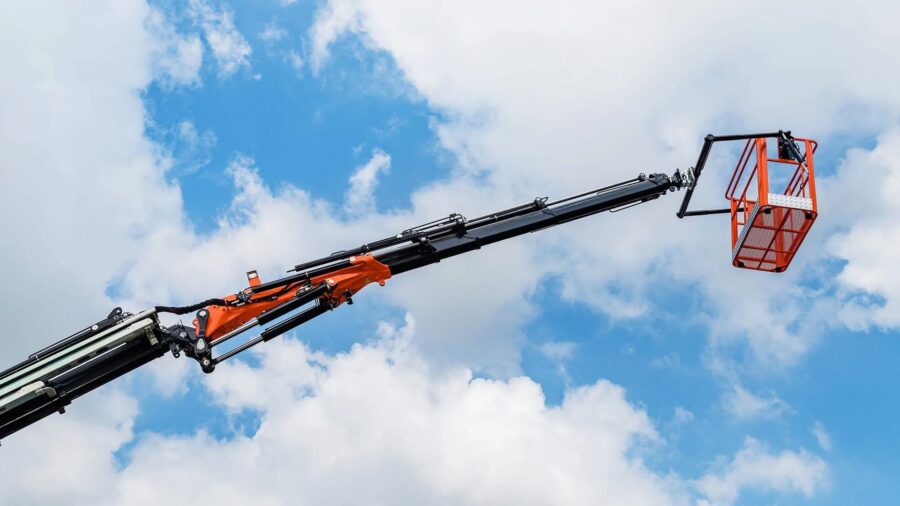
A crane basket is a certified enclosure attached to a crane’s load line, used to lift personnel to height when no other access method is practical. The basket is suspended from the crane’s load line and is designed to keep operators secure while they carry out tasks at elevation.
Fitted with an EN280 kit, a crane basket can to all effects be classified as a MEWP in its own right; without it, it falls under “exceptional use” provisions. Either way, under UK regulations this falls under LOLER (Lifting Operations and Lifting Equipment Regulations) and requires a documented risk assessment showing that lifting people with a crane is justified over other methods, in line with PUWER and the Work at Height Regulations (WAHR 2005).
Crane baskets vary by leveling system:
- gravity (passive) baskets: self-level naturally, no mechanical intervention. Simple and reliable for standard lifts on relatively stable ground;
- controlled-leveling baskets: a mechanical system corrects the platform’s angle as the crane arm moves, adding stability on uneven terrain;
- active-leveling baskets: hydraulic or electro-hydraulic systems continuously adjust the platform’s position, keeping it level even in complex or dynamic conditions.
Choosing between these levels ultimately comes down to how demanding the site conditions are: the more unstable the terrain or the more precision the task requires, the more the investment in a controlled- or active-leveling basket pays off in safety and operational reliability.
What is a MEWP?
A Mobile Elevating Work Platform is a self-propelled or towable machine. It includes its own drive system, power source, and controls, making it fully autonomous in operation, independent of any crane. Common types include:
- Scissor lifts: vertical access on flat, stable ground; electric or rough-terrain versions, typically used for indoor work and general maintenance;
- Articulated and telescopic boom lifts: both vertical and horizontal outreach, useful for working around obstacles;
- Tracked/spider lifts: compact machines built for soft, sloped, uneven or confined ground where wheeled machines can’t operate safely;
- Truck-mounted platforms: boom lifts mounted on a vehicle for fast redeployment between sites.
MEWP operation in the UK is governed by the Work at Height Regulations 2005 (WAHR) and PUWER, which require operators to be adequately trained and competent before using this type of equipment. In practice, this means holding IPAF certification, the industry-recognised standard accepted by principal contractors, hire companies and site managers across the UK.
Key differences between crane baskets and MEWPs
Beyond the basic definitions, the practical choice between a crane basket and a MEWP comes down to a handful of factors that directly affect cost, timing and feasibility on your specific site. Here’s what to weigh up:
- reach and height: crane baskets can go well beyond most MEWPs, in some cases over 100 metres, making them the go-to for very tall structures like industrial plants, bridges or high-rise façades. Most MEWPs top out between 20 and 60 metres;
- mobility: MEWPs are self-propelled and easy to reposition on their own. Crane baskets depend on crane availability and coordination for every move — though on sites where a crane is already in use, adding a basket is often the most efficient option available;
- ground conditions: standard wheeled MEWPs need stable, flat ground, though tracked and spider variants handle slopes and soft soil. Crane baskets go further still: with the crane properly set up, they can reach over obstacles, water or terrain no ground-based platform could access;
- load capacity: both support operators and tools, with capacity depending on the model. Advanced self-levelling crane baskets can carry multiple operators and heavier equipment when needed;
- cost and availability: MEWPs are widely available for hire and cost-effective for short jobs. Crane baskets need an existing crane on site, but on large projects where a crane is already mobilised, that overhead is negligible.
When to choose a crane basket
Choose a crane basket when:
- Height exceeds what available MEWPs can reach
- Ground conditions rule out safe MEWP deployment
- Access is needed over obstacles, water or irregular terrain
- A crane is already on site and can be used for dual purpose
- Precise horizontal positioning is required (active-leveling models)
- Work involves shipbuilding, wind energy, bridge construction or industrial maintenance at extreme height
When to choose a MEWP
Choose an MEWP when:
- Height is within 20–60 metres and ground is stable
- Frequent repositioning is needed across the site
- No crane is available or mobilising one isn’t justified
- Indoor maintenance or installation work
- Short-duration tasks that benefit from quick setup and teardown
Conclusion
Ultimately, the right choice isn’t about which piece of equipment is “better”, it’s about matching the tool to the job. Height, ground conditions, site layout and the equipment already available all play a part, and getting this decision right at the planning stage avoids costly delays and unnecessary risk further down the line. Whichever option fits your project, working with well-maintained, properly certified equipment and trained operators remains the single biggest factor in keeping the job both safe and efficient.