The modern workplace is in a state of flux. While the advent of remote work has been years in the making, the pandemic represents a turning point that has made work-from-home setups part of the new normal.
But even as UK employers look towards a slow transition back to the office, the great remote work experiment caused by COVID may become permanent. In a recent survey of 3,000 UK professionals by RADA Business, nearly half or 45% said they were very or extremely interested in working remotely permanently in a post-pandemic world. Younger workers between the ages of 16 and 34 were particularly in favour of it.
This paradigm shift only reinforces the importance of operating in a cloud computing environment. As employees move away from co-located offices, the agility and flexibility of cloud services offer the key to staying connected and productive.
Here’s how.
1. Enhanced Data Security
Despite popular belief, there’s no evidence to support the notion that the cloud is less secure than on-premise IT infrastructure. In fact, the Oracle and KPMG Cloud Threat Report 2020 shows that 75% of cybersecurity and IT professionals from both public and private organisations consider the cloud to be more secure than on-prem servers. Meanwhile, 12% said the cloud was just as safe as an on-prem environment.
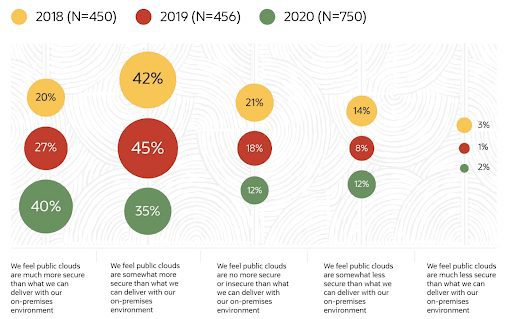
Image Source: Oracle and KPMG Cloud Threat Report 2020
For businesses, this means your IT teams no longer have to devote so much of their time and attention to cybersecurity. While cloud-based systems are by no means bulletproof, they offer advanced features such as real-time breach detection and advanced firewalls.
2. Real-Time Data Visibility
Cloud-based software and platforms offer business owners a wealth of data and insights that can be viewed in real-time. But what does that mean in terms of real-world productivity?
Here’s a scenario. Let’s say one of your employees is abroad on a business trip. Any travelling worker knows that filling in travel expense forms at the end of the trip is about as exciting as watching paint dry. They also need to keep a copy of all their receipts, which they’re required to attach to their expense claims.
But with cloud-based travel expense management software, employees simply need to take a photo of their receipts using their phone and send it to HR using the app. The platform collates this information and prepares the form for approval — all without human intervention.
HR also has access to all the data they need to monitor a travelling employee’s spending and whether their expenses are within the company’s corporate travel policy — no need to pore over spreadsheets for several hours.
3. Task Automation
For many businesses, the words “artificial intelligence” and “automation” can set off alarms, stoking fears about software replacing humans. But in truth, automation is a lot less exciting.
Make no mistake, automation is still transformative. Moving your applications and data to the cloud can significantly reduce the number of hours spent on time-consuming and repetitive tasks.
Take chatbots, for example. Adopting a cloud-based chatbot platform can free your contact centre teams from responding to frequently asked questions about your products and services. The chatbot automatically answers common questions and escalates conversations that need a human touch to your live agents whenever necessary.
4. Agility and Flexibility
Agility used to be something exclusive to disruptive startups that used emerging technologies to pivot into new verticals and adapt to consumer trends at the drop of a hat. But agile concepts have quickly made their way to small and medium enterprises (SMEs), driven by the advent of cloud computing.
For example, cloud-based collaboration apps like Slack and Microsoft Teams enable real-time communication and file sharing, reducing your dependence on email. On the other hand, browser-based design platforms like Canva allow teams to work on shared designs simultaneously.
Over to You
Whether or not remote work is here to stay is anyone’s guess. But one thing is for sure — the future of work will be in the cloud. Embracing cloud computing systems will unlock opportunities to improve your performance and productivity, keeping you ahead of the competition. Your business may not move all of your workloads to an offsite server, but some of your mission-critical processes will likely operate through some kind of cloud-based platform in the near future.
Author: Todd Gifford
 Todd’s world can be a detailed and complex one. As a Certified Information Systems Security Professional (or CISSP for short), with over 20 years of experience in IT and Information Security, Todd helps customers understand the risks with their information, where it is stored and processed and how best to manage those risks in our ever-evolving digital world. He writes a mean blog and prides himself in turning technical language into simple sentences we can all understand.