2020 paved the way for a monumental shift in working arrangements. Across the globe, the coronavirus pandemic forced businesses of all shapes and sizes to shut their offices and embrace hybrid working.
Fast forward to today, and businesses are looking to overhaul their working practices, in favour of embracing flexible working arrangements in the form of remote or hybrid working. But with many business leaders eager to go back to the office, and back to the traditional way of working, are we at a societal tipping point?
Where remote working was once the niche, it’s quickly becoming the norm, and in reality, the UK has long been on the path to hybrid working, long before a worldwide pandemic made it the vogue thing to do!
But this shift raises questions: Are business leaders in danger of ruining staff morale? How does hot desking fit into the question? What does the future of work look like?
Join us as we determine whether hot desking and hybrid working are a fad that will lose momentum after the pandemic – or if they’re something that’s here to stay.
What is hybrid working?
Hybrid working means a workforce has the flexibility to both work from home and work within their public office during their week. That means employees have the freedom and flexibility to choose what work arrangements work best for them. For some, it might be 2 days a week remote working and 3 days in the office. For others, it might be a 80-20 split.
Support for hybrid working has been mixed, and has only accentuated the attitude divide between employees and employers. On the one hand, employees are in favour of hybrid working, with 72% arguing that it enables them to strike a better work-life balance, and 41% of employees going as far as to say they would be likely to resign if they were forced to return to the office against their will after working remotely.
On the other hand, many are rallying against this approach now restrictions have been lifted, reverting back to the old ways of working.
Where does hot desking fit into all this?
Hot desking is a method of ensuring hybrid working can be facilitated. It’s an office based system whereby desks are used by different people at different times, on an ad hoc basis.
Pre-pandemic, hot desking was popular amongst coworking and office spaces, and Google search data shows that the interest in host desking has been on a steady climb since 2004, showing the UK public has an appetite to work more flexibly.
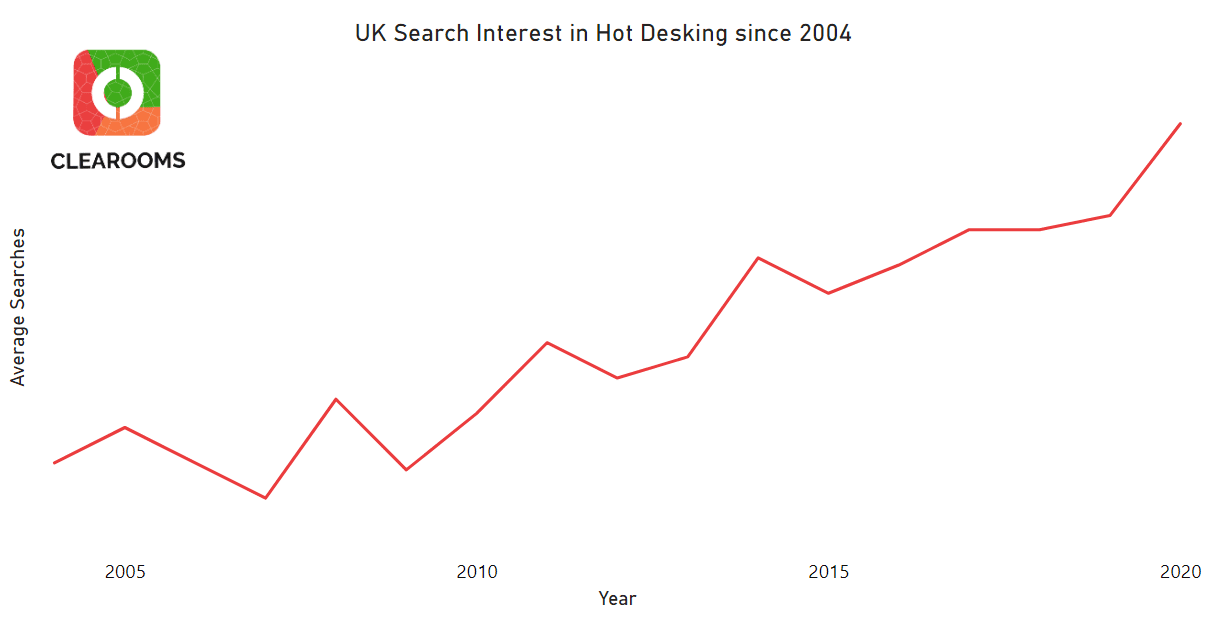 Searches for hot desking in UK
Using Google Trends data, we can see a clear rise in interest for hot desking over the last sixteen years:
| Year | Average Searches |
| 2004 | 13 |
| 2005 | 18 |
| 2006 | 13 |
| 2007 | 8 |
| 2008 | 22 |
| 2009 | 12 |
| 2010 | 20 |
| 2011 | 30 |
| 2012 | 25 |
| 2013 | 28 |
| 2014 | 42 |
| 2015 | 37 |
| 2016 | 41 |
| 2017 | 46 |
| 2018 | 46 |
| 2019 | 48 |
| 2020 | 61 |
What does the data tell us about the future look of hybrid working and hot desking?
Whilst this massive transition to remote working during the pandemic was a necessity for office-based companies, the majority of companies have shown that they want to continue with some form of remote work post-pandemic. In fact, it’s estimated that 72% of the global workforce is now working remotely, according to an ETR survey.
Big names such as Ford, Dropbox, Salesforce and Facebook have all thrown their support behind hybrid and remote working, with a recent Gartner survey demonstrating that 80% of employers plan to allow employees to work remotely at least part of the time after the pandemic, and 47% will allow employees to work from home full-time.
The pandemic has accelerated a way of working that he has seen coming for years. While things are certainly not going to change overnight, it seems likely that hybrid working is going to outlast the pandemic. We’ve seen a culture shift in the way we work for some time, but it’s been hyper-accelerated by a pandemic that essentially forced businesses around the world to do a trial-run.
According to a report by Microsoft, over 70% of employees want flexible remote working options to continue and 65% want the chance to be able to meet their colleagues in person – those aren’t two contrary positions, they want the ability to do both.
It’s no surprise that the likes of Microsoft and Google have already implemented working models like this, tech companies always seem to be ahead of the curve for this stuff. The question is, how long will it take more ‘traditional’ businesses to get with the programme and realise that their workforce is calling out for flexibility?
Benefits of hybrid working go far beyond staff
It’s not just employees that reap the rewards of hybrid working. It’s been seen to increase productivity and job satisfaction, improve mental health and work-life balance, but not only that, it’s been seen to help attract and retain talent. 96% of employees desire some form of remote working, 81% saying they would be more loyal to their employer if they had flexible work options.
But going beyond the benefits for employees and employers, hybrid and remote working is good for business. With increased productivity, businesses are more profitable, losing less business to workplace distractions.
Better still, hybrid working is much environmentally friendly, with greenhouse gas emissions reduced through less people commuting. Hybrid workers also make environmentally sound choices, such as less printing, and smaller, or less utilised office spaces means less spent on heating and lighting. Statistically, remote workers have the same potential impact on air quality as planting an entire forest of 91 million trees.
Who are Clearooms?
Clearooms is a workspace management tool to support a safe return to the office with hot desk and meeting room booking. With a straightforward set up process, you can be up and running in minutes.
Check it out at www.clearooms.com.