The latest House Price Index for the final quarter of 2019 highlights house prices in Northern Ireland increased by 0.2% in the last three months and by 2.5% compared to last year. This is equivalent to a typical home costing £3,400 more than it did at the end of 2018, writes Jordan Buchanan, Chief Economist at PropertyPal.
Northern Ireland recorded the 3rd fastest rate of growth across all 12 UK regions, trailing only Wales and Yorkshire & Humber area. The wider UK housing market showed more modest price growth of 1.6%, largely driven by weaker growth in the core South East of England and London.
Figure 1: UK Regions annual house price growth
Since the Brexit referendum there has been no clear evidence of a slowdown with local prices over 12.4% higher than mid-2016 levels and by 9.3% across the UK.
To date the standardised home price in Northern Ireland is approximately £140,200 following five consecutive years of growth in house prices as the property market continues its recovery from the financial crash in 2007-08.
Property prices increased across all property styles, except for apartments, compared to Q4 2018:
- Detached homes increased by 3.7% to £210,200, an increase in value of £7,500.
- Semi-detached homes increased by 3.1% to £136,200, an increase in value of £4,100.
- Terrace homes increased by 1.8% to £98,100, an increase in value of £1,800.
- Apartments decreased by 2.1% to £109,300, a decrease in value of £2,300.
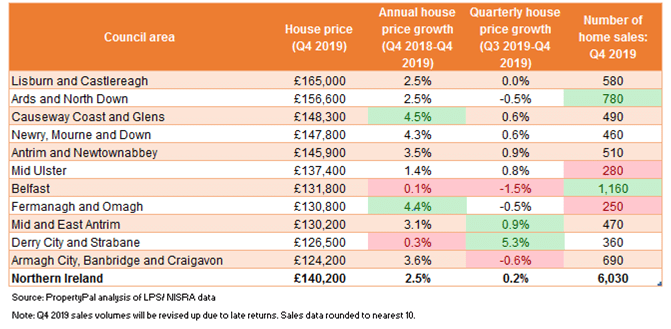
Beneath the headline figure for Northern Ireland, there is considerable variation in prices at the council level. House prices are the most expensive in Lisburn and Castlereagh at £165,000 and the most affordable in Armagh, Banbridge and Craigavon, costing closer to £124,200.
Figure 2: Northern Ireland council area house prices and sales volumes; Q4 2019
House prices are a closely watched economic indicator by a range of stakeholders; homeowners, aspiring buyers, policy makers and the general public. They provide an important barometer of underlying consumer confidence and wider economic performance. The volume of transactions and housing completions or starts are less commonly discussed indicators, despite arguably being a more meaningful measure of economic health.
Despite recent economic uncertainty, there doesn’t appear to be any significant slowdown in homebuyer’s activity in the market. There were 6,025 homes sold in the final quarter of 2019 however, with the caveat that this will be revised up in the coming months due to late returns.
PropertyPal forecast this will be revised to 6,750 using our recently published Transaction Tracker. For context, there has been an average of 6,330 homes sold in the final quarter of each year since 2014.
The construction of new dwellings peaked at over 14,000 in 2006 with the vast majority of house building for private sector activity. Following the market correction in 2007/08 there was a sharp downturn in building levels with only 5,500 homes completed each year on average between 2011-2015. Since then, the market has shown signs of a sustainable recovery and was reflected in 7,440 new homes completions in 2019, a similar volume to 2018 levels (7,640).
The most housing completions were in Armagh, Banbridge and Craigavon (1,040), Lisburn & Castlereagh (820) and Mid Ulster (750). The fewest completions were in Mid & East Antrim (435) and Fermanagh & Omagh (430).
Of more concern, the prospects for housebuilding look to be lower in 2020. Completions tend to lag housing starts by around nine months and there has been a significant drop in starts compared to last year – 7,280 starts compared to 8,620 in 2018, a decline of 15%. Lower housing starts are a symptom of weaker economic conditions in addition to wider industry concerns surrounding planning and essential infrastructure capacity constraints, notably for sewerage. With housing supply expected to slow in the coming year it is likely this will provide some upward support for house prices.
All things considered; this was a generally positive performance for the local property market. House prices are continuing their recovery at sustainable rates and closer aligned to wage growth, alongside transaction numbers which aren’t sending any warning signals of consumers holding off on their home purchase. Furthermore, the latest labour market data released earlier this week continues to show resilience and strength in the jobs market.
Whilst the fundamental economic drivers of house price growth remain strong, the outlook remains more ambiguous. The longer term economic and housing market performances are vulnerable to the outcome of the UK-EU Brexit negotiations following the end of the transition arrangement later this year.