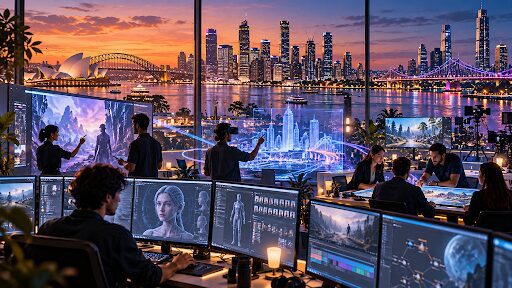
Australia’s digital entertainment industry is developing into a significant part of the country’s creative and technology economy. Sydney, Melbourne and Brisbane are increasingly attracting game developers, visual effects studios, technology startups and international production companies seeking skilled talent and advanced infrastructure.
The expansion reflects more than growing demand for entertainment. Government incentives, digital innovation, international investment and university partnerships are helping establish these cities as competitive production centres in the Asia-Pacific (APAC) region.
With the Australian game development industry generating A$608.5 million in revenue during the 2024–25 financial year, digital entertainment represents a growing commercial opportunity for Australian businesses and international investors.
Australia’s Digital Entertainment Economy Is Expanding
Digital entertainment has moved beyond traditional television, cinema and console gaming. Consumers now engage with interactive content through smartphones, streaming platforms, cloud services and immersive technologies.
The wider market also includes interest in online pokies in Australia, alongside mobile gaming, esports and digital entertainment subscriptions. Although gambling and conventional video games operate under different regulatory frameworks, both demonstrate the importance of digital interfaces, secure payment systems and user engagement in modern entertainment.
According to the Interactive Games & Entertainment Association (IGEA), Australia’s video game development sector supported approximately 2,443 full-time positions in FY2025.
Several interconnected industries are contributing to this digital expansion:
- Video game development: Independent studios, mobile games and AAA productions.
- Visual effects (VFX): Computer-generated imagery, animation and post-production.
- Immersive media: Virtual reality (VR), augmented reality (AR) and extended reality (XR).
- Digital streaming: Online video distribution and interactive content.
- Creative technology: Real-time rendering, motion capture and virtual production.
These sectors create opportunities for software developers, creative professionals, production companies and technology investors.
Sydney, Melbourne and Brisbane: Three Distinct Entertainment Ecosystems
Each city offers different strengths within Australia’s expanding digital entertainment industry.
| City | Industry strengths | Key organisations and infrastructure |
| Sydney, NSW | VFX, animation, virtual production, creative technology | Tech Central, Industrial Light & Magic, UTS |
| Melbourne, VIC | Video game development, indie gaming, interactive media | PlaySide Studios, VicScreen, Cremorne Digital Hub |
| Brisbane, QLD | Mobile gaming, animation, digital production | Halfbrick Studios, Screen Queensland, Fortitude Valley |
Their complementary capabilities strengthen Australia’s position as a regional centre for entertainment technology.
Sydney: A Centre for Visual Effects and Creative Technology
Sydney has established itself as an important location for visual effects, animation and technology-driven screen production.
International businesses such as Industrial Light & Magic (ILM) operate in the city, while the former Animal Logic animation studio now forms part of Netflix Animation Studios.
Sydney’s Tech Central innovation precinct connects technology companies, research institutions, universities and startups. Its proximity to the University of Sydney and the University of Technology Sydney (UTS) supports collaboration between creative industries and software engineering.
The UTS Animal Logic Academy contributes specialist training in animation and visualisation.
Meanwhile, Vivid Sydney demonstrates how digital art, projection mapping and immersive experiences can support tourism, creative businesses and the nighttime economy.
For investors, Sydney combines production infrastructure with access to technology companies, venture capital and international business networks.
Melbourne: Australia’s Leading Video Game Development Ecosystem
Melbourne has developed a particularly strong reputation for video game production and interactive entertainment.
Companies such as PlaySide Studios demonstrate the commercial potential of Australian-developed intellectual property. The Melbourne-based developer and publisher produces games across mobile, PC, console and immersive platforms.
Victoria’s broader ecosystem benefits from the Cremorne Digital Hub, which connects startups, universities, investors and established technology businesses.
Industry events also strengthen Melbourne’s international presence. Melbourne International Games Week brings together developers, publishers and gaming enthusiasts, while PAX Australia and Games Connect Asia Pacific (GCAP) provide opportunities for networking and business development.
VicScreen supports local game development through production funding, incentives and professional development programs.
These initiatives help studios access financing, develop original intellectual property and connect with international distribution partners.
Brisbane: A Growing Destination for Gaming and Digital Production
Brisbane is becoming increasingly competitive within Australia’s digital entertainment economy.
The city is home to Halfbrick Studios, the developer behind internationally recognised mobile games Fruit Ninja and Jetpack Joyride.
Halfbrick’s success demonstrates how Australian studios can develop digital products for global audiences without relying exclusively on major international publishers.
Brisbane’s broader creative economy includes animation, post-production, software development and interactive media businesses.
Areas such as Fortitude Valley contribute to the city’s creative and technology business environment, while Queensland University of Technology (QUT) supports the development of digital media and technical talent.
Screen Queensland also provides industry assistance through production incentives, games grants and professional development initiatives.
For companies considering expansion, Brisbane offers an established games industry alongside opportunities to build new teams and production capabilities.
How Emerging Technologies Are Transforming Production
Technology is increasingly connecting Australia’s entertainment and software industries.
Game engines such as Unreal Engine and Unity allow developers to create sophisticated interactive environments, while also supporting animation, architectural visualisation and virtual production.
Real-time rendering enables creative teams to preview complex scenes during production, reducing dependence on lengthy traditional rendering processes.
Other important developments include:
- Motion capture (MoCap): Converting human movements into digital animation.
- Computer-generated imagery (CGI): Creating visual content for film, television and gaming.
- Cloud gaming: Delivering interactive games through remote computing infrastructure.
- Artificial intelligence: Supporting production workflows, testing and digital asset creation.
- Spatial computing: Connecting physical environments with immersive digital experiences.
These technologies allow entertainment businesses to develop products and services across multiple industries.
Government Incentives Are Supporting Investment
Financial incentives are another important reason Australia’s entertainment sector attracts commercial attention.
The Australian Government’s Digital Games Tax Offset (DGTO) provides eligible developers with a 30% refundable tax offset on qualifying Australian game development expenditure, subject to a minimum expenditure threshold of A$500,000.
Gambling and substantially gambling-like games are excluded from the incentive.
Film and screen production businesses may also qualify for federal programs such as the Producer Offset, Location Offset and Post, Digital and Visual Effects (PDV) Offset.
At the state level, VicScreen and Screen NSW provide additional industry support.
Queensland offers a particularly competitive environment through Screen Queensland’s Digital Games Incentive, which supports eligible projects equivalent to 15% of qualifying Queensland development expenditure.
Together, these programs can improve project economics, support local employment and encourage foreign direct investment (FDI).
Why Skilled Talent and Universities Matter
Access to qualified professionals remains essential for entertainment businesses.
The University of Sydney, RMIT University, the University of Melbourne and QUT contribute through education and research in software development, animation, design and digital technologies.
Australia’s creative workforce increasingly requires expertise across both artistic and technical disciplines.
These capabilities include software engineering, digital asset creation, UX design, computer graphics, animation and interactive storytelling.
STEM education, industry partnerships and skilled migration also influence the availability of specialists.
For production companies, proximity to universities and research institutions can support recruitment, training and innovation.
The Business Outlook for Australia’s Digital Entertainment Hubs
Sydney, Melbourne and Brisbane are positioned to benefit from continued developments in interactive entertainment and creative technology.
However, investors must also consider production costs, competition for skilled workers, intellectual property ownership and the financial risks associated with lengthy development cycles.
Businesses capable of combining original content with efficient production technology may be better positioned to compete internationally.
Ultimately, Australia’s greatest advantage lies in the connections between its creative industries, technology businesses, education institutions and government programs.
As these ecosystems mature, Sydney, Melbourne and Brisbane have the potential to strengthen Australia’s role as a leading digital entertainment production and innovation centre in the APAC region.