For hospitality and tourism businesses, families are a valuable and unpredictable market. They book earlier than most, they stay longer when they’re comfortable, and they tell other parents exactly what they thought. A venue that makes life easy for a table of adults and two restless children tends to get the repeat visit. One that doesn’t rarely finds out why.
Among the factors that decide this, outdoor space is increasingly the one that separates the venues families return to from those they merely tolerate. And in a market like Northern Ireland, where a dry afternoon can’t be guaranteed, how that space is planned matters as much as whether it exists.
Why it pays
The commercial case rests on dwell time. A family with something for the children to do outside will linger over a second round of drinks, order dessert, and stretch a Sunday lunch into mid-afternoon. The adults stay relaxed because the children are occupied, and the spend follows.
For accommodation providers the effect shows up in reviews. Parents are specific when they write about holidays: whether there was somewhere for the little ones to burn off energy before bedtime, whether it felt safe, whether the kit looked cared for. Those details end up in the ratings that drive the next booking.
Start with what you can actually supply
The temptation is to buy a single impressive structure and hope it does the work. In practice, the venues that handle this well tend to start with something less glamorous: a good supply of simple outdoor toys that can be put out when the weather allows and stored when it doesn’t. Balls, hoops, chalk, ride-ons and sand tools are cheap to buy, easy to replace and endlessly flexible, and a basket of them by the door signals that children are expected and welcome.
It also lowers risk. Loose equipment can be checked at the start of each day, repaired or retired without ceremony, and adjusted to suit whoever happens to be in. A fixed structure can’t be.
Where fixed equipment makes sense
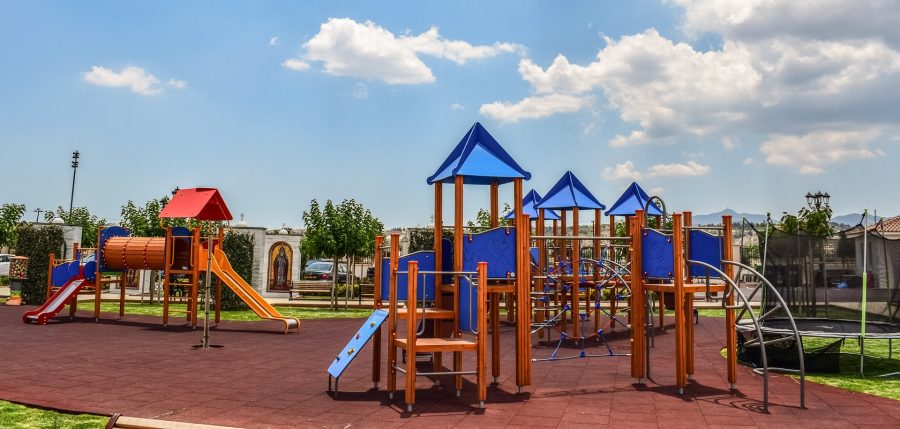
For venues with the space and a steady family trade, permanent outdoor play equipment can be a sensible investment, but it needs to be treated as a commercial installation rather than a garden purchase.
Equipment intended for public use should meet the relevant British and European standards, which cover design, installation and the impact-absorbing surfaces beneath it. Products made for domestic use are built to a different specification and aren’t designed for the volume of use a venue generates. Installation should follow the manufacturer’s instructions, and regular inspection and maintenance need to be built into someone’s routine, with a record kept.
The legal and insurance position varies with the type of premises, so it’s worth speaking to your insurer and checking current guidance before anything goes in the ground.
Plan for the weather
Rain is a design constraint, not a surprise. The venues that cope best have a covered or semi-covered area where play can carry on, a surface that drains rather than turning to mud, and an indoor fallback with a few things for children to do while the weather passes.
Drainage and surfacing are often where budgets get underestimated. Bark, rubber mulch and sand are all used, each with different maintenance needs, and it’s worth asking what a surface will look like in February rather than July.
Don’t forget the adults
The best family spaces are designed so parents can see the children from where they sit. Sightlines, comfortable seating and shelter for the adults make a bigger difference to dwell time than the equipment itself. Put the play area where staff can also keep an eye on it, and keep it clearly separate from car parks and roads.
Think about accessibility too. Children with additional needs and their parents notice quickly whether a space has been thought about, and they tend to share that as well.
Keep it fresh without rebuilding
Repeat visits depend on the offer feeling alive. Rotating the loose equipment, adding seasonal touches, or setting up a simple activity for school holidays gives regulars a reason to come back without major expense. A mud kitchen in spring, a bug hunt in summer, a lantern trail in the darker months: none of it needs much, but all of it gives families something to mention.
The practical test
Before committing a budget, it helps to ask three questions. Would a parent with two children under six feel comfortable here for two hours? Could staff manage and inspect the space within their existing routine? And would the whole thing still look cared for after a wet winter?
If the answer to all three is yes, the investment is likely to pay back. If not, it’s better to start smaller and build up, because a tired, half-broken play area does more harm to a venue’s reputation than having none at all.