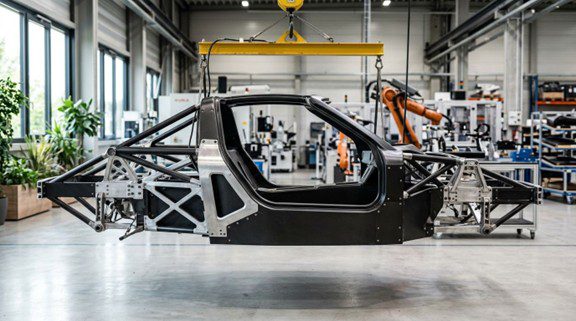
The automotive industry is undergoing one of its most significant structural shifts in decades. At the heart of this transformation lies vehicle lightweighting, a manufacturing philosophy that prioritises reducing a vehicle’s overall mass without compromising safety, performance, or durability. As emissions regulations tighten and electric mobility accelerates, cutting unnecessary weight has become one of the most effective levers manufacturers can pull to improve efficiency and meet sustainability targets.
The logic is straightforward: lighter vehicles require less energy to move, whether powered by an internal combustion engine or a battery pack. For electric vehicles in particular, reducing mass directly extends range, which remains one of the central concerns for consumers and fleet operators alike. But lightweighting is not simply about swapping heavy steel for lighter alternatives. It demands a rethinking of materials science, design engineering, and supply chain strategy from the ground up.
In 2026, this rethinking is happening at scale, driven by advances in aluminium processing, composite materials, and digital design tools that make precision engineering more accessible than ever before.
TL;DR — Key Takeaways
- Vehicle lightweighting is a core manufacturing priority in 2026, driven by stricter emissions targets and the growth of electric vehicles.
- Aluminium remains the dominant lightweight material across both structural and body panel applications.
- Advanced composites, high-strength steels, and multi-material assemblies are increasingly used alongside aluminium.
- Sustainable production methods are integral to lightweighting strategies, not just an afterthought.
- Digital tools including simulation software and AI-assisted design are accelerating lightweighting innovation across the automotive supply chain.
Why Vehicle Lightweighting Has Moved to the Centre of Automotive Strategy
For much of the twentieth century, vehicle weight was an engineering compromise rather than a strategic priority. Heavier vehicles often felt more substantial, and the cost of lightweight materials made widespread adoption impractical. That calculus has changed decisively.
Regulatory Pressure and Emissions Targets
Government bodies across major automotive markets have introduced progressively stricter carbon dioxide emissions standards. These rules place a direct obligation on manufacturers to reduce fleet-wide emissions, and since aerodynamic drag and rolling resistance both scale with vehicle mass, lightweighting delivers measurable reductions in real-world fuel consumption and tailpipe output.
Every 100 kilograms removed from a conventional vehicle is estimated to reduce fuel consumption by roughly 0.3 to 0.5 litres per 100 kilometres. For a manufacturer with millions of vehicles on the road, the cumulative impact on emissions compliance is substantial. In 2026, the stakes are even higher as regulators move closer to enforcing targets that were set years in advance, leaving manufacturers little room for delay.
The Electric Vehicle Weight Paradox
Battery electric vehicles present a particular engineering challenge. Battery packs are heavy, often adding 400 to 600 kilograms to a platform compared with an equivalent internal combustion drivetrain. Without aggressive lightweighting elsewhere in the vehicle structure, this weight penalty undermines range, handling, and tyre wear.
This creates what engineers sometimes call the lightweighting paradox for EVs: the very technology designed to reduce environmental impact introduces a new weight burden that must be offset. The answer lies in reducing mass throughout the body-in-white, closures, chassis, and interior components, turning lightweighting from a desirable feature into a structural necessity for competitive electric vehicle development.
Materials Driving the Lightweighting Revolution in 2026
No single material dominates the lightweighting landscape. Instead, manufacturers increasingly adopt multi-material strategies, selecting the best option for each component based on its load requirements, manufacturing process compatibility, and lifecycle sustainability profile.
Aluminium: The Workhorse of Lightweight Design
Aluminium has established itself as the most widely deployed lightweight structural material in automotive manufacturing. Its combination of low density, high strength-to-weight ratio, corrosion resistance, and recyclability makes it suitable for an exceptionally broad range of applications, from body panels and door inners to crash structures and battery enclosures.
The role of aluminum in car manufacturing extends well beyond simple weight reduction. Aluminium’s formability allows complex shapes to be produced with fewer components, simplifying assembly and reducing joining costs. Its thermal conductivity is also increasingly valued in electric vehicles, where managing battery heat is critical to performance and safety.
Recycled aluminium, produced using only a fraction of the energy required for primary smelting, has become central to the sustainability credentials of the material. Closed-loop recycling programmes, in which end-of-life vehicle aluminium is returned to the production cycle with minimal quality loss, are now standard practice among progressive manufacturers and their materials suppliers.
Advanced High-Strength Steel and Composites
High-strength and ultra-high-strength steels continue to play a significant role in vehicle lightweighting, particularly in safety-critical structural zones where controlled deformation during a crash is engineered with precision. While denser than aluminium, these steels allow for thinner gauges that offset much of the weight difference while maintaining or improving structural integrity.
Carbon fibre reinforced polymers and glass fibre composites offer the most dramatic weight savings of any material class, but their cost and the complexity of manufacturing and repair have historically restricted their use to premium and performance vehicles. By 2026, advances in automated fibre placement, thermoplastic processing, and recycled carbon fibre are beginning to bring composite components within reach of mainstream vehicle platforms, though full-scale adoption remains a medium-term ambition rather than a present reality.
Sustainable Lightweighting: Balancing Mass Reduction and Environmental Responsibility
Weight reduction alone does not guarantee sustainability. A component that saves mass during its operational life but generates significant carbon emissions during production, or proves difficult to recycle at end of life, may deliver a net negative environmental outcome when assessed across its full lifecycle.
Lifecycle Assessment as a Design Tool
Automotive manufacturers and their Tier 1 suppliers are increasingly applying lifecycle assessment methodology from the earliest stages of component design. This approach assigns an environmental cost to every kilogram of material, every manufacturing process step, and every kilometre of transport in the supply chain.
Aluminium produced using renewable energy and high recycled content scores well under lifecycle assessment, making it a genuinely sustainable lightweighting material rather than simply a convenient one. The full picture matters, and companies that can demonstrate a robust, data-supported lifecycle case for their material choices are gaining a competitive advantage in an industry where procurement decisions are increasingly influenced by sustainability metrics.
| Material | Density (g/cm³) | Relative Weight Saving vs. Steel | Recyclability |
| Mild steel | 7.8 | Baseline | High |
| High-strength steel | 7.8 | 10–20% (via thinner gauge) | High |
| Aluminium alloy | 2.7 | 40–55% | Very high (incl. closed-loop) |
| Carbon fibre composite | 1.6 | 50–65% | Limited (improving) |
| Magnesium alloy | 1.8 | 55–65% | Moderate |
Supply Chain Transparency and Responsible Sourcing
Beyond the material itself, manufacturers face growing pressure to demonstrate that lightweighting gains are not achieved at the cost of irresponsible raw material sourcing. Bauxite mining for primary aluminium production, for example, carries environmental and social implications that responsible procurement strategies must address.
The shift towards higher recycled content in aluminium supply chains directly reduces dependence on primary extraction, addressing both the carbon intensity of smelting and the land-use implications of mining. Suppliers that can offer verified recycled content, backed by certification and transparent chain-of-custody data, are increasingly preferred by vehicle manufacturers who face their own scrutiny from investors, regulators, and consumers.
Digital Innovation and the Future of Lightweighting Engineering
Materials selection is only one dimension of vehicle lightweighting. How components are designed, optimised, and validated has been transformed by digital engineering tools that were not available at scale even a few years ago.
Topology Optimisation and Generative Design
Topology optimisation software analyses a component’s load environment and identifies which regions of material are structurally necessary and which can be removed. The result is often a biomorphic, lattice-like structure that carries loads efficiently while using the minimum material required. These forms would have been impossible to manufacture using traditional methods, but additive manufacturing and advanced casting techniques now make them viable for production applications.
Generative design takes this further, using artificial intelligence to explore thousands of design variants simultaneously against defined performance and weight targets. Engineers set the constraints and the software generates candidates, which can then be filtered, refined, and validated through virtual testing before a physical prototype is ever produced.
Digital Twins and Virtual Validation
The digital twin concept, in which a detailed virtual model of a component or full vehicle is maintained throughout its lifecycle, has become a standard element of advanced automotive development programmes. For lightweighting, digital twins enable manufacturers to test how weight reduction decisions in one area affect structural performance, NVH characteristics, and crash behaviour across the whole system.
| Lightweighting Technology | Maturity Level in 2026 | Primary Application |
| Aluminium body structures | Established / mainstream | Body-in-white, closures, crash structures |
| High-strength steel rollforming | Established / mainstream | Pillars, sills, floor structures |
| Carbon fibre composites | Growing / premium/performance | Roof panels, battery housings |
| Topology-optimised castings | Expanding into mainstream | Suspension, structural nodes |
| Generative AI design tools | Emerging / R&D to production | Brackets, mounts, structural members |
| Thermoplastic composites | Emerging | Interior structures, underbody |
Virtual validation reduces the number of physical test cycles required, compressing development timelines and lowering the cost of exploring unconventional lightweight designs that might otherwise be considered too risky to prototype. In a market where speed to launch is a competitive differentiator, this matters enormously.
Frequently Asked Questions
What is vehicle lightweighting and why does it matter in 2026?
Vehicle lightweighting refers to the engineering and materials strategies used to reduce a vehicle’s overall mass while maintaining or improving its safety, performance, and durability. In 2026 it matters more than ever because electric vehicle adoption is accelerating the need to offset heavy battery pack weight, and emissions regulations are pushing manufacturers to demonstrate measurable reductions in fleet-wide carbon output. Lighter vehicles consume less energy, deliver longer range in EVs, and generate fewer lifecycle emissions.
Which materials are most commonly used for vehicle lightweighting?
Aluminium alloys are the most widely adopted lightweight structural material across the automotive industry, valued for their strength-to-weight ratio, formability, corrosion resistance, and recyclability. High-strength steels remain important in safety-critical structures, and carbon fibre composites are growing in use for performance and premium applications. Multi-material strategies, combining different materials based on the specific requirements of each component, are increasingly the norm rather than the exception.
How does sustainable manufacturing relate to vehicle lightweighting?
Sustainable manufacturing and vehicle lightweighting are closely connected, but weight reduction alone does not guarantee a positive environmental outcome. Lifecycle assessment tools are used to evaluate the full environmental cost of a material choice, including production energy, recycled content, and end-of-life recyclability. Materials such as aluminium produced with high recycled content and renewable energy can offer both significant weight savings and a genuinely low-carbon profile across the complete product lifecycle.