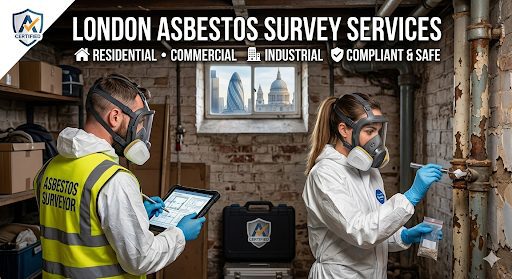
The commercial real estate market in London is a high-stakes environment where the excitement of a new acquisition can often mask past liabilities. From the historic facades of the West End to the mid-century office blocks of the City, many of London’s iconic properties share a common, invisible legacy: asbestos.
For any prospective buyer, business owner, or landlord, understanding the implications of this material is vital. It is not just about health; it is about legal survival and financial security.
In this blog, we will explore why a professional Asbestos Survey London is the single most important piece of due diligence you can perform before completing a property purchase.
1. The Historical Context: Why London is an Asbestos Hotspot
We must look at how London was built to understand the risk. Following the industrial revolution and the reconstruction efforts after World War II, asbestos was hailed as the “miracle mineral.” Its fire-resistant properties, tensile strength, and affordability made it a staple in UK construction for decades.
-
The Peak Years (1950s–1980s)
During these decades, asbestos was integrated into almost every type of building material imaginable. In a fast-moving city like London, it was used in high-rise offices, retail units, and industrial estates. It wasn’t until 1985 that blue (crocidolite) and brown (amosite) asbestos were banned, followed by a total ban on white (chrysotile) asbestos in 1999.
-
The “Year 2000” Rule
Because the total ban only took full effect at the end of 1999, the general rule for London property is simple: If the building was constructed or refurbished before the year 2000, it is legally presumed to contain asbestos until proven otherwise.
2. Defining the “Duty to Manage” Under UK Law
One of the biggest surprises for new commercial property owners is the shift in legal responsibility. In the UK, the law doesn’t care if you didn’t put the asbestos there; it only cares that you now own it.
-
The Control of Asbestos Regulations 2012 (CAR 2012)
This is the primary legislation governing asbestos in non-domestic premises. It creates a “Duty to Manage,” which falls on the owner, the landlord, or the tenant, depending on the terms of the lease.
What the Duty-Holder Must Do:
- Identify: Locate all Asbestos-Containing Materials (ACMs) within the building.
- Assess: Determine the condition of those materials and the risk of fiber release.
- Record: Maintain a written Asbestos Register and Management Plan.
- Inform: Ensure that anyone likely to disturb the material (such as maintenance staff or contractors) is fully aware of its location and condition.
Failure to uphold these duties is a criminal offense. The Health and Safety Executive (HSE) can issue “Prohibition Notices” that shut down your business overnight, accompanied by unlimited fines or even imprisonment for serious negligence.
3. The Science of the Risk: Why is it Dangerous?
Education is the best tool for safety. To understand why an Asbestos Survey London is non-negotiable, we must understand how asbestos interacts with the human body.
-
Microscopic Fibers
Asbestos is not dangerous if it is in good condition and left alone. The danger arises when the material is damaged, drilled, or sanded. This releases microscopic fibers into the air. These fibers are so small that they can bypass the body’s natural filters and lodge deep within the lungs.
-
The Latency Period
Unlike a chemical burn or a fall, asbestos-related diseases take a long time to manifest, often 20 to 50 years after exposure. This “latency period” means that the exposures occurring today in London’s shops and offices are the health crises of the future.
-
Related Health Conditions:
- Mesothelioma: A terminal cancer of the lining of the lungs, almost exclusively caused by asbestos.
- Asbestosis: Severe scarring of the lung tissue that makes breathing increasingly difficult.
- Lung Cancer: Asbestos exposure significantly increases the risk of lung cancer, especially in smokers.
4. The Two Types of Surveys You Need to Know
Not all surveys are created equal. Depending on your plans for the property, you will need a specific type of inspection.
-
The Management Survey (The Standard Check)
This is the most common survey for property acquisitions. Its purpose is to locate ACMs that could be disturbed during normal occupancy or simple maintenance. It is non-intrusive and ensures you can safely operate the building day-to-day.
-
The Refurbishment and Demolition (R&D) Survey
If you plan to modernize the property, knock down walls, or overhaul the infrastructure, a Management Survey is not enough. An R&D survey is fully intrusive. It involves looking behind wall panels, under floorboards, and within ceiling voids.
5. Financial Benefits: The Survey as a Negotiation Tool
An asbestos survey is a financial “shield” from a purely business perspective. In the London market, where every square foot is expensive, unexpected remediation costs can destroy your ROI.
-
Avoiding Post-Completion Costs
Specialist asbestos removal in Central London involves strict licensing, air monitoring, and hazardous waste disposal fees. If you discover you need to remove asbestos after you’ve bought the building, you are looking at thousands of pounds in unbudgeted costs.
-
Leveraging the Findings
If your Asbestos Survey London identifies materials in poor condition, you have a professional document that allows you to:
- Negotiate a Price Drop: Request that the seller lower the price by the estimated cost of remediation.
- Conditional Sale: Demand that the seller remove or encapsulate high-risk materials before the exchange of contracts.
- Risk Assessment: Decide if the building’s structural health aligns with your long-term investment goals.
6. How the Survey Process Actually Works
Knowing what to expect can take the stress out of the process. At FRA London, we follow a rigorous, scientific approach to ensure your data is accurate.
-
Step 1: The Site Audit
A certified surveyor walks through every accessible part of the property. They look for common ACMs such as:
- Artex and Textured Coatings: Common on ceilings and walls.
- AIB (Asbestos Insulating Board): Often found in ceiling tiles and partition walls.
- Floor Tiles and Bitumen: Frequently hidden under modern carpets.
- Pipe Lagging: Used extensively in older heating systems.
-
Step 2: Sampling and Laboratory Analysis
Suspicious materials are sampled under controlled conditions to prevent fiber release. These samples are sent to UKAS-accredited laboratories. The lab will confirm the exact type of asbestos:
- Chrysotile (White): The most common type.
- Amosite (Brown): High risk and often found in insulation boards.
- Crocidolite (Blue): The most hazardous form.
-
Step 3: The Report and Management Plan
You receive a detailed document that acts as your “Asbestos Register.” It includes photos, locations, and a risk rating. More importantly, it tells you exactly what to do next, whether that is simply monitoring the material or arranging for professional removal.
7. The Future of Your Investment: Property Development
London is a city in a constant state of reinvention. Most commercial buyers intend to change the layout or upgrade the facilities.
-
Why DIY or General Contractors Aren’t Enough
A general builder is not trained to identify asbestos. If they accidentally drill into an asbestos-insulated pipe, they can contaminate the entire building. This triggers an “Emergency Decontamination” scenario, which is exponentially more expensive than a planned removal. By starting with a professional survey, you ensure that your development project starts on a foundation of safety.
-
Why Choose FRA London for Your Journey?
At FRA London, we believe that property compliance should be transparent, straightforward, and supportive. We don’t just hand you a report and leave; we partner with you to manage your property’s long-term health.
- Experience: Years of combined industry expertise across London.
- Clarity: We avoid jargon and provide actionable advice.
- Innovation: 24/7 access to your reports via our Online Client Portal.
- Value: Competitive pricing with commercial shop surveys starting from £299.
Conclusion: Knowledge is the ultimate long-term health Safety Measure
Buying a commercial property in London is a significant achievement. It represents your ambition and your future. Don’t let that future be shadowed by the building materials of the past.
An asbestos survey is an investment in your people, your legal standing, and your financial peace of mind. By making it a non-negotiable part of your buying process, you ensure that your new London address is a safe place to do business for years to come.
Ready to secure your property? Let’s work together to make your building safety-verified and compliant.