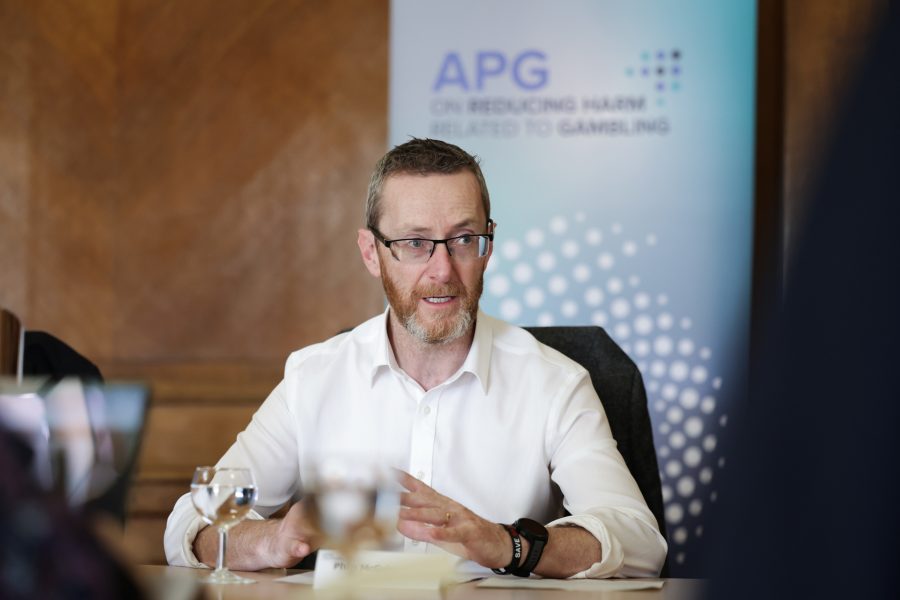
At a roundtable of the Assembly All Party Group on Reducing Harm Related to Gambling, participants were told of the critical gap in gambling harm treatment services in Northern Ireland. There are currently no dedicated statutory treatment services for individuals experiencing gambling related harms, while there are 15 NHS gambling harms clinics in England which offer multidisciplinary care including clinical psychologists, therapists, psychiatrists, and peer support workers.
A briefing and update from the All Party Group presented at the roundtable highlights a stark disparity between Northern Ireland and other parts of the UK, with experts warning that urgent action is needed to address what is increasingly being recognised as a significant public health issue.
Despite growing awareness of the harms associated with gambling addiction, psychologists and psychiatrists within Health and Social Care (HSC) Trusts are not resourced to treat gambling disorders. Instead, support is largely dependent on underfunded community and voluntary organisations, including Extern Problem Gambling, Dunlewey Addiction Services, Cuan Mhuire, Chapter One, and Gamblers Anonymous.
While these organisations provide valuable services, from helplines to counselling, there is no co-ordinated, statutory treatment pathway.
The roundtable brought together politicians, healthcare professionals, frontline service providers, Stormont officials and experts to discuss the future of gambling treatment services in Northern Ireland.
The event featured insights from Dr Matt Gaskell MBE, Consultant Psychologist and head of the NHS Northern Gambling Service, and Prof Henrietta Bowden-Jones OBE, Consultant Psychiatrist and National Advisor on Gambling Harms to NHS England. They shared lessons from their experience rolling out NHS gambling harms services across England.
A presentation from Oscar Donnelly, former Director of Mental Health at the Northern Trust, outlined a proposed model for treatment and support services in Northern Ireland informed by All Party Group recommendations on a public health approach to tackling gambling related harms.
Among the issues discussed were the importance of having clear pathways for self-referral, there being “no wrong door” for people experiencing gambling harms, and the need for statutory services and charities to work together.
Gambling harm treatment services
The roundtable discussion follows the publication of the first clinical guidelines on gambling harms by the National Institute for Health and Care Excellence (NICE), which were formally endorsed by the Department of Health in Northern Ireland in June 2025. The guidelines recommend routine screening for gambling harms in healthcare settings. However, the Department has acknowledged that full implementation would require significant new investment or a fundamental redesign of services.
In response to a motion brought to the NI Assembly in January 2025 that gambling should be recognised as a public health issue, Health Minister Mike Nesbitt acknowledged that gambling can be harmful to health but stated that funding for new services must come from new or additional funding if a public health approach is to be adopted.
Speaking after the roundtable, Philip McGuigan MLA, Chair of All Party Group on Reducing Harm Related to Gambling and Chair of Stormont’s Committee for Health, said: “The All Party Group has consistently called for gambling to be treated as a public health priority, with cross-party support reinforced by an Assembly motion passed in January 2025.
“Central to these proposals is the introduction of an industry-funded levy on gambling operators. While legislation exists to introduce a levy on land-based operators here, implementation remains at an early stage and would not apply to online gambling companies due to outdated regulatory frameworks.
“This contrasts with Britain, where a statutory levy introduced in April 2025 is expected to raise nearly £120 million annually. Funds are allocated to research (20%), prevention (30%), and treatment (50%).
“However, online gambling companies do not pay a levy on bets taken in the North, despite these companies being able to advertise and operate in the region if licensed in Britain. As a result, they are effectively operating in an unregulated market locally without contributing to harm reduction services.”
The APG is advocating to receive a fair share of levy funding generated by remote operators. Estimates suggest that, under the Barnett formula, this could amount to approximately £2.7 million annually for treatment and prevention services.
“This is funding that could transform support for individuals and families affected by gambling harms,” added McGuigan. “But there is currently no guarantee it will be allocated to the north.”
Comparative models demonstrate what could be achieved. In Wales, £1.3 million per year from levy funding has been allocated to a Health Board to deliver a specialist gambling treatment service and national helpline, launching in April 2026.
Visit https://www.gamharmapg.org/ and follow the APG on social media for further information.