
For modern founders, the pressure to innovate is constant. Technologies like IoT (Internet of Things), automation, and smart systems promise increased efficiency, better customer experiences, and long-term cost savings. But one critical question remains: is implementing these technologies a strategic investment or just another expensive experiment?
The answer depends not on the technology itself, but on how and when it is applied.
Understanding the Real Value of Smart Technologies
Smart technologies, particularly IoT, are often positioned as transformative solutions. And in many cases, they are. By connecting devices, collecting real-time data, and enabling automation, businesses can streamline operations and unlock new revenue streams.
However, not every company is ready to benefit from this transformation. For early-stage startups or SMEs with limited resources, poorly planned implementation can lead to high costs without meaningful returns.
The key is to shift the mindset from “adopting technology” to “solving a specific business problem.”
When IoT Becomes a Strategic Investment
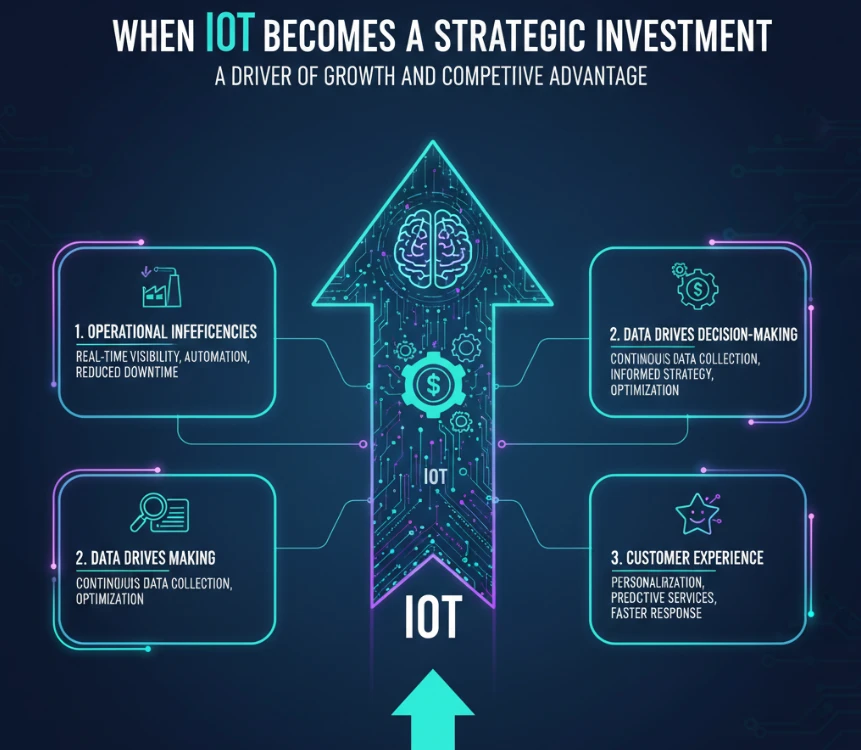 IoT delivers the most value when it directly impacts core business metrics. This typically happens in three scenarios:
1. Operational inefficiencies are measurable and recurring
If your business struggles with consistent inefficiencies such as equipment downtime, energy waste, or supply chain delays, IoT can provide real-time visibility and automation to address them.
2. Data can drive better decision-making
Companies that rely on assumptions rather than data often miss optimization opportunities. IoT enables continuous data collection, allowing founders to make informed, evidence-based decisions.
3. Customer experience is a differentiator
In competitive markets, personalization and responsiveness can set a brand apart. Smart technologies enable tailored experiences, predictive services, and faster response times.
In these cases, IoT is not just a cost it becomes a driver of growth and competitive advantage.
When It Becomes an Expense
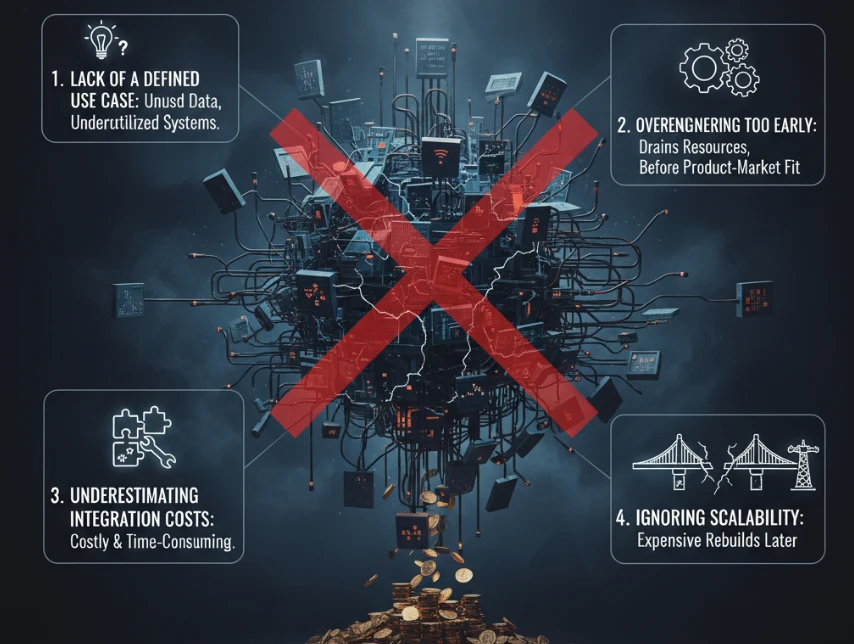 On the other hand, IoT can quickly turn into a financial burden if implemented without a clear strategy.
1. Lack of a defined use case
Deploying smart devices without a specific goal often leads to unused data and underutilized systems.
2. Overengineering too early
Startups sometimes invest in complex infrastructure before achieving product-market fit. This can drain resources that are better spent on validating the core business.
3. Underestimating integration costs
IoT systems rarely operate in isolation. They need to integrate with existing platforms, databases, and workflows. Without proper planning, integration can become costly and time-consuming.
4. Ignoring scalability
A solution that works for a small operation may fail under growth conditions. Rebuilding systems later is often more expensive than designing them properly from the start.
The Importance of Execution
Even with a strong use case, success depends heavily on execution. IoT solutions involve multiple layers hardware, connectivity, cloud infrastructure, data processing, and user interfaces. Each layer introduces complexity.
When scaling a startup, the decision to automate processes often hinges on technical execution. Strategic IoT software development can provide a significant competitive edge, but only if executed correctly. For most SMEs, the most cost-effective path is to partner with an established software development company that can transform a vision into a functional, scalable product without the overhead of an in-house team.
This approach allows founders to focus on business strategy while leveraging external expertise to handle technical challenges.
How to Evaluate ROI Before You Invest
To determine whether IoT is a worthwhile investment, founders should conduct a structured evaluation:
1. Define the problem clearly
What specific issue are you trying to solve? Quantify its impact in terms of cost, time, or lost revenue.
2. Estimate potential gains
How much can be saved or earned by solving this problem? Consider both direct and indirect benefits.
3. Calculate total cost of ownership
Include not just development costs, but also maintenance, upgrades, and integration expenses.
4. Start with a pilot project
Instead of a full-scale rollout, test the solution on a smaller scale. This reduces risk and provides valuable insights.
5. Measure and iterate
Track performance metrics and refine the system based on real-world data.
This disciplined approach helps ensure that decisions are based on business value rather than hype.
Balancing Innovation with Practicality
Founders often face a tension between staying innovative and remaining financially disciplined. Smart technologies can be powerful tools but only when aligned with business goals.
The most successful companies are not those that adopt the most technology, but those that adopt the right technology at the right time.
Conclusion
Implementing IoT and smart systems is neither inherently an investment nor an expense it becomes one or the other based on strategy, timing, and execution.
For founders, the goal should not be to chase innovation for its own sake, but to use technology as a means to solve real problems, improve efficiency, and create value. With a clear use case, careful planning, and the right technical support, smart technologies can become a powerful engine for growth rather than a costly distraction.