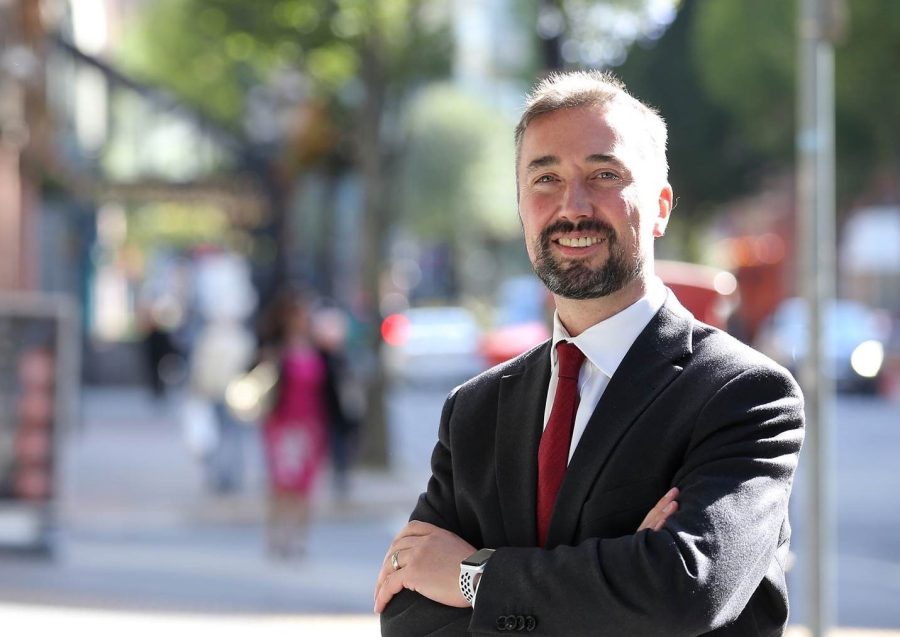
A few weeks ago, Belfast City Council completed purchase of the historic Assembly Rooms on the Four Corners. It was a positive, uplifting decision that had cross party-political support and was enthusiastically welcomed by both business and built environment groups. As well as preserving a significant heritage building, the purchase opens the door to wider regeneration of this neglected area, writes Chris McCracken, MD at Linen Quarter BID
Belfast hasn’t always enjoyed a good reputation for preserving its heritage, but this purchase got me thinking how much this has recently changed. In a period of just three years an astonishing 15 heritage projects have been completed or commenced within, or just outside, the city centre.
The story starts on 1 November 2022 when the Bank Buildings opened its door as the reborn home of Primark. In 2018 the entire building, completed in 1900 on the site of the original 18th century bank, was destroyed in a devasting fire. The city centre was scarred for years, and few thought they would see this beautiful building again. But in a remarkable renewal, like a phoenix from the flames, it was authentically reconstructed in its original form with an astonishing £102m investment. It was a powerful symbol of what our city could achieve, recalling the determination and vision of our Victorian zenith.
The following year two more heritage projects were completed by the City Council. The £17m refurbishment of Templemore Baths (the very street where this writer was born), and the £7.3m renovation of St Comgall’s School into a community hub. Both opened in June 2023, providing benefits to the West and East of the City.
Projects accelerated in 2024. The Ivy Restaurant opened at the old Robinson & Cleavers on Donegall Place in September. Sadly, without its famous marble staircase, which was purchased by Lord Ballyedmond in the 1980’s and now graces the family castle at Rostrevor. One would hope the stunning £8m ground floor refurbishment would inspire further works on the rest of the building. Also in September the Flint hotel reopened after an £11m restoration by the Ringland Brothers.
The building originally opened as the Presbyterian War Memorial Hostel in 1925, so 100 years later it was fantastic to see the renewal of the beautiful stone façade and the high quality repurposing of the interior into the expanded hotel and Amelia Hall bar.
In October that year the Pearl Assurance building on Donegall Square East reopened as shared office space, with Black Sheep Coffee on the ground floor. The building had been purchased by MJM Marine, whose owner, Brian McConville, described the £7m refurbishment as a labour of love.
This is the ethos directly channelled from our Victorian ancestors, where buildings were not merely functional, but were statements of civic pride. It has been inspiring to see the red Ballochmoyle sandstone re-emerge in its pristine glory, the Gothic revival architecture augmented by pointed arches, oriel windows, and intricate carvings featuring gargoyles, animals and monarchs. I truly hope that Brian will be long remembered for his wonderful gift.
Equally important was the £16.5m renovation of the 1895 red brick and industrial steel Printworks on Queen Street, now housing Nine Square Coffee. The restoration of the street has been impressive, new entrants include the Student Roost, Home 2, and the forthcoming Queen Street Hotel.
The final project of 2024 was the completion of the Entries by the City Council. These narrow alleys date back to the 1600’s and were the original core of Belfast’s commercial and social life. In total 11 entries were renovated, including paving, lighting, street art, and historical interpretations. They are now thriving hubs once again, attracting significant new investment into adjacent hospitality venues.
Momentum continued into 2025 with another four projects completed. £3m was invested in restoring the Cathedral Buildings on Donegall Street, following a devasting fire in 2022. £5.5m was spent on the purchase and restoration of Clarence Street Chambers by the Clover Group, which now houses the jaw dropping Margot, along with Rudi nightclub.
The honey stone Ewart building, which had been derelict for half a century, was restored by McAleer and Rushe as part of the £88m Bedford Square development. It opened in October, housing Catalyst work space and Loaf Café. And outside the City Centre the “Recreate a Great Place North” illuminated 8 heritage buildings, reminding us of the superb architectural legacy of North Belfast.
And we are not done yet, as a further pipeline of work is already underway. The 1904 Scottish Mutual building on Donegall Square South is part of a £21m restoration by the Martin Property Group. It is due to open early in 2026 as the luxury Bedford Hotel, boasting 102 bedrooms and creating 125 jobs.
In 2027 the former Bryson House, whose sandstone exterior has already been renovated by McConnell Stone, is due to open as Untold: The Museum of the Irish Solider, costing £13.6m. While in 2030 comes the biggest project of them all – the £100m Belfast Stories, with the 1930 Art Deco Bank of Ireland building at its heart.
The total cost of these 15 heritage projects is £400 million. It is a remarkable level of investment. And what has been the story of this success?
First the vision. The City was shocked into action by the devastation from the Bank Buildings Fire, but people were determined to get Belfast back on track.
Second the role of the City Council, the civic leaders of the City who have led from the front and inspired change.
Third, the individual examples of business leaders like Brian McConville and the Ringland Brothers, or the commitment of corporate groups, who wanted to deliver buildings that were beautiful and not just functional.
And finally, ensuring the restored heritage buildings had a commercial use with sustainable business models at their heart. Business and heritage belong together.
There are still many heritage assets at risk, such as Riddle’s warehouse on Ann Street. But there is no denying that the City has come a long way in a short time.
Belfast – you should be proud.