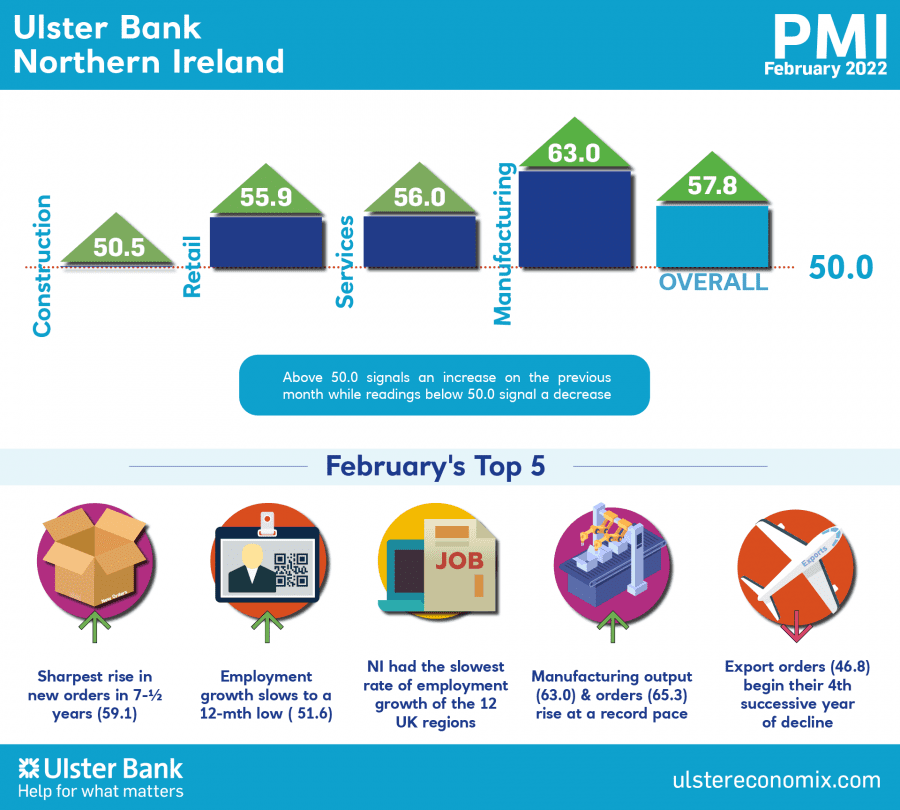
Today sees the release of February data from the Ulster Bank Northern Ireland PMI®. The latest report – produced for Ulster Bank by IHS Markit – pointed to improved growth momentum, with both new orders and business activity up sharply. Firms were only able to raise employment modestly, however, amid reports of difficulties sourcing staff. Meanwhile, rates of inflation remained elevated but showed further signs of easing.
Richard Ramsey’s commentary on Ulster Bank Northern Ireland PMI
Commenting on the latest survey findings, Richard Ramsey, Chief Economist Northern Ireland, Ulster Bank, said: “With concerns over Covid-19 fading fast, Northern Ireland’s private sector posted a surge in activity in February. Output hit an eight-month high, with all four sectors recording growth for the first time since June last year. Meanwhile, new orders rose at their fastest pace in seven-and-a-half years. Only construction, of the four sectors monitored, failed to record an uplift in new orders last month.
“Despite robust demand, employment growth slowed to a 12-month low, with Northern Ireland posting the slowest rate of job creation of the 12 UK regions. Clearly firms are struggling with skills shortages and are finding it difficult to get suitable candidates to help meet the demand.
“Manufacturing was the best performer at a sector level by a significant margin. Output and orders in the sector expanded at record rates while manufacturing firms continued to increase their headcounts to cope with burgeoning order books and mounting backlogs.
“February’s PMI report was therefore very encouraging across a number of levels.
“However, the economic outlook has changed drastically with Russia’s invasion of Ukraine. Commodity prices have rocketed, and an unprecedented array of sanctions have been imposed on Russia.
“Businesses therefore face a new source of supply chain disruption. Clearly the primary concern is with the people of Ukraine and the severe situation they face. But businesses and households here in Northern Ireland are also set to be impacted by the situation too, most particularly through the rampant inflation in energy and food prices, as well as the general uncertainty.”
The main findings of the February Ulster Bank Northern Ireland PMI
The headline seasonally adjusted Business Activity Index posted 57.8 in February, up from 54.7 in January and signalling a marked expansion in output across the private sector. All four broad sectors saw activity increase midway through the first quarter, with the strongest expansion in manufacturing. Firms expanded output in line with accelerated growth of new orders, with new business rising at the fastest pace since July 2014.
Despite accelerated growth of output and new orders, the rate of job creation slowed amid reports of difficulties finding candidates. The rise in employment was modest and the slowest in the current 12-month sequence of expanding workforce numbers. Subsequent staff shortages, as well as ongoing supply-chain disruption and strong new order growth meant that backlogs increased at the sharpest pace in eight months.
Rates of inflation of both input costs and output prices remained elevated, despite showing further signs of softening. Higher energy and fuel prices were widely mentioned by panellists.
Optimism in the 12-month outlook for business activity hit a three-month high in February, with firms expecting the impact of the COVID-19 pandemic to be reduced and new orders to continue expanding.