
The internet allows us to reach a global audience and many websites, whether selling products or services, find that a surprising number of their clients are international, even if they didn’t set out with the intention to attract an international audience.
So, how can you attract more visitors internationally?
One way is to build links from a range of countries (and if you have a multilingual website, in a range of languages) and this article gives you a clear guide on how to do this for the best results and common pitfalls to avoid.
Google also place substantial value on incoming links and strong links will improve your SEO considerably. The country that the backlinks are from make a difference as to where you will rank on local versions of Google, so the more links you have from UK orientated sites, say, the higher you will rank on google.co.uk.
To quote Google:
“In general, webmasters can improve the rank of their sites by increasing the number of high-quality sites that link to their pages.”
The steps to successful international link building to improve your SEO are:
- Do country specific keyword research
- Set up your multilingual website
- Build relevant international links in each relevant language
This is different to local SEO in one important aspect – every step needs completing in each language, including having relevant backlinks to your site.
1. Do country specific keyword research
 When you translate content from one language to another or focus on building your traffic from another English speaking country, it’s important to make sure that you use terms that have sufficient search volume in the target country. Your backlink also won’t sit on an empty page, but to obtain backlinks you will have to write guest posts, social media shares, infographics, or other content, and that content should include important keywords that are also mentioned on your website.
For international SEO, the first stage is therefore keyword research, for both on-page SEO and link building.
There are often several different phrases that can be used to describe the same thing. Phrase A might be searched for 10,000 times a month and Phrase B might be searched for 100 times a month. If you don’t do language specific keyword research, you risk losing 99% of your traffic by using Phrase B without realising the consequences.
Most keyword research tools only show you global traffic, however there are a couple of tools that are particularly suited for this.
Google’s Keyword Tool
If you use Google’s Keyword Tool for your research, then it’s also essential that you specify both the country AND the language to narrow down your search. If you’re targeting an international audience (e.g. all German speakers) and you just select ‘German’ in the language box, then it still shows the international keyword volume, but filters it to words in German. This means that if the word is multi-national (e.g. hotel) then you will get far higher search volumes than is accurate.
To prevent this problem, select ‘German’ for language, but then add all relevant European countries, in this example Germany, Austria and Switzerland in the location box.
SEMrush
SEMrush allows you a few free searches, so think about what you want to search for before you start if you’re not planning on buying the paid version.
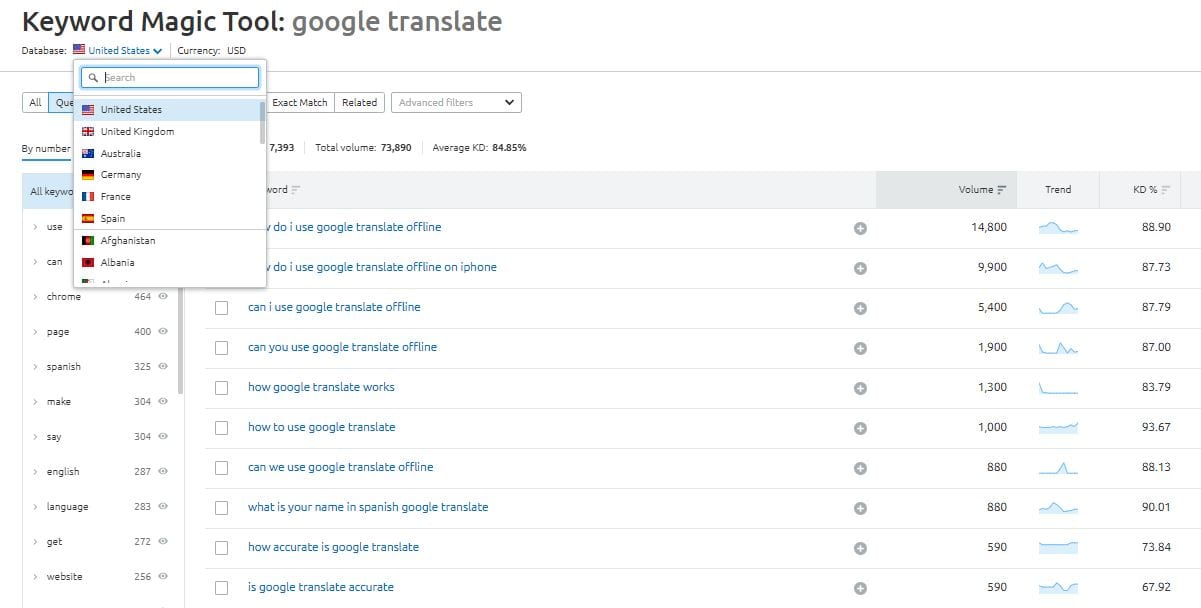
Using SEMrush’s keyword magic tool, enter a relevant keyword then click the drop-down arrow to choose the country (as shown below). If you’re considering what guest posts to write, then there’s also a very handy ‘Questions’ feature. Click it to show how many people enter exact questions each month into Google from a specific country – this is an easy way to decide what topics to write about in your guest posts.
The example below shows questions about “Google translate” with monthly search volumes from the USA.
There are also a wide selection of other free keyword research tools available, so be sure to check different options to decide which is best for you.
2. Set up your multilingual website

If you don’t yet have one, the first step is to create a multilingual website. The top CMS systems like Drupal, PrestaShop and WordPress have modules or add-ons that make th–is relatively simple, however if you have a custom CMS, this may require extra configuration.
However you choose to configure your site, it’s essential that each page in each language has its own unique URL (web address) and that you don’t use hashtags in the URL as the sole way to control the language. If you use only cookies or hashtags to control which language is shown, then Google will be unable to index those pages and you risk only one language being shown in the search results.
If you’re creating a new website, then the best long-term solution is normally to use a single database with multiple domain names (e.g. a .fr for France, .de for Germany, .it for Italy, etc.) this is because:
- Using international domain names is great branding. People in France will see a .fr domain and immediately assume that you’re in France.
- If you have a keyword rich domain name (which is recommended if you sell a single product or service, but not if you sell a wide variety of products), it allows you to translate this into each language.
- Your .fr domain will receive a boost in rankings from Google.fr, helping local SEO.
- Having a single database means you can make future modifications to design, etc. once and it will immediately impact all your websites.
One note on translations, automatic translations are progressing well, but they’re still far from perfect and using them risks you look like a fool, as well as Google labelling your content as ‘automatic content’ and therefore penalising it. It’s fine to use an automatic translation as a starting point but be sure that a fluent native speaking translator reviews it before it goes live.
See more tips on multilingual SEO.
3. Build relevant links in each language
 If you’re launching a niche product with little competition, then an intense international link building campaign (say 2-4 months) is likely to be all you need to rank well with Google, though you will need to do ongoing link building in order to keep a high position, otherwise it’s like sit down in a race – your competitors will eventually overtake you.
If you’re launching a product or service in a more competitive field, then it may well take longer to appear high with Google for that language/country. Even if you have a high authority site that already ranks well in one language, there’s no guarantee that a new site in a different language will still rank well.
SEO companies will charge anywhere between a few hundred and a few thousand dollars a month for a successful link building campaign, as it involves writing content, creating or sourcing images to accompany articles and contacting webmasters to arrange to place guest posts on high authority sites, as well as potentially running a social media marketing campaign.
What if you don’t have the budget for a multilingual link building campaign?
If this is the case, a good strategy is to choose one language (based on your keyword research) and to start with, focus all your links on that country, then once you’re generating a healthy return on investment, launch your next link building campaign in a second language.
If you want to reach the European marketplace for example, it might seem like you will get the best return on investment translating your site into a dozen languages, but actually a small link building campaign in twelve languages is unlikely to be sufficient to rank you for any of them. Doing a larger campaign has the potential to put you in the first few results on Google for that language, which is essential to succeed.
How do you build relevant links internationally?
There are some useful multilingual link building tips on Indigoextra’s blog. Here’s a summary of the main recommendations:
- Search for the keyword by itself and submit your site to any directories or submit articles to any blogs you find from non-competitors on the top 30 pages in the search results.
- Use infographics and images – infographic marketing is a great SEO strategy, however they’re time consuming to create. If you’re completing an international SEO campaign in 4 languages, say, you can translate the infographic, which is a lot faster than creating 4 infographics from scratch.
- Focus on quality and relevance, NOT volume. If the link wouldn’t make sense to a human being, odds are it won’t make sense to Google and won’t give you the SEO benefit you’re looking for.
- As far as possible 100% of links should be from the same language as the site you’re linking to. Don’t be tempted to hyperlink French anchor text on an English article (for example), as this won’t work.
What’s the best way to approach webmasters with a guest post?
Webmasters tend to receive a lot of requests for guest posts, so you need to do something to help make your approach stand out. It’s also best for SEO that each guest post is only published once. One way to engage webmasters is to phone in the first instance and ensure that you’re emailing the guest post to the right person; another way is to follow the process summarised below:
- Write an engaging guest post and include one or two images as part of it.
- Save this as a PDF so that the webmaster can’t easily copy and paste it without checking with you first.
- Email 3 different webmasters and attach the guest post itself (most people don’t do this, and it means that there’s an extra hoop to jump through, so you are more likely to be ignored).
- If you get no response after 1 week, chase them again. If you get no response after 2 weeks, check your guest post and covering email to see if you can improve them and repeat the previous step.
- If one webmaster says, “Yes”, that’s great, send them the article as a Word document with the images attached separately.
- If two or three webmasters say, “Yes”, congratulations, you clearly wrote a fantastic guest post. Choose your favourite site to be published on and email them the Word document and images, then email the other webmasters a different article and say, “Sorry, I actually just heard from another blogger and have arranged to publish the article on their site, however I would be delighted if you would consider the attached article instead.”
There’s always a certain amount of patience involved in guest posting, particularly international guest posting, however the above strategy gives you the maximum chance that your guest posts will be accepted, without requiring too long a delay.
While social media marketing, directory submissions and other forms of link building (provided the focus is on quality, not quality) will all help your SEO, most SEO experts consider guest posts to be the best form of link building.
Guest posts are themselves likely to rank well in the search results and can be placed on high authority sites with plenty of traffic – which means you’ll get more direct traffic from them, and they will also help your site rank higher with Google, making them the ideal backlink.