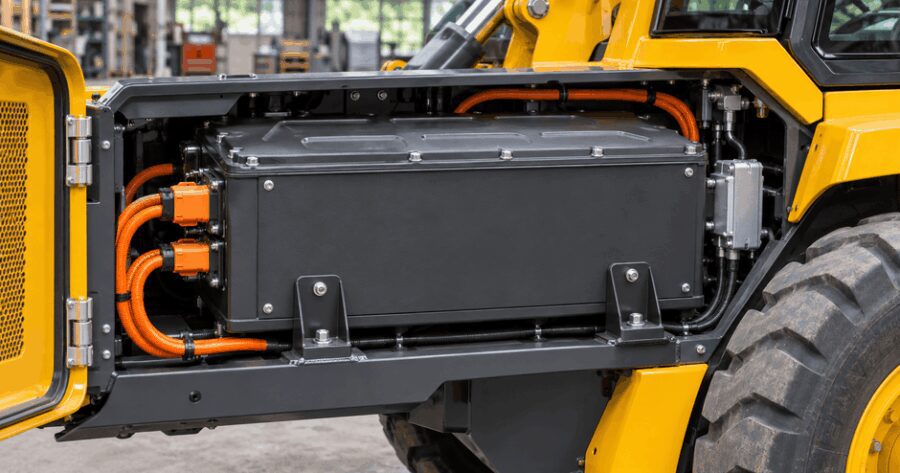
An electric excavator can have enough battery capacity on paper and still fall short on site. If the battery limits power while the operator is lifting and slewing, the machine may slow down even with plenty of charge left. That is where a fully integrated battery system earns its place. It gives you a way to design around what the machine actually does during a shift.
Direct Answer: A fully integrated battery system gives machine builders a battery pack whose monitoring, protection and communication functions are designed to work together. That can reduce custom engineering, make prototype behaviour easier to diagnose and simplify servicing. The gains depend on how well the supplier’s scope matches the machine’s duty cycle and interfaces.
Spend Less Engineering Time on Battery Integration
A battery pack has to fit the machine, supply its peak loads and tell the machine controller when available power changes. If you source the pack, battery management system and protective components separately, your team has to define how they work together and investigate faults across supplier boundaries. A supplier that delivers those functions as a tested assembly can take on part of that work. Ask for a written scope, since chargers, cooling hardware and machine-side wiring may still sit with your team.
The biggest time saving often comes when something goes wrong on the prototype. If the machine suddenly loses power, your engineers need to know whether the battery requested a reduction, communications dropped or the motor controller reached its own limit. With documented signals and fault codes, they can narrow down the cause before swapping parts or changing settings. Ask the supplier to show what the machine controller receives during a normal power reduction and during a fault.
Size the Battery for the Work It Has to Do
Capacity in kilowatt-hours helps you estimate runtime. The power the battery can deliver, and for how long, determines whether the machine can complete its hardest tasks at the expected speed. A compact loader might use modest power while travelling, then demand much more when it drives into a pile and lifts a full bucket. Repeating that cycle can expose a limit that a short demonstration misses.
Give your supplier a representative shift profile with working loads, idle time, ambient temperatures and charging breaks. If you have data from an existing machine, include how long the peaks last and how often they occur. Use the profile to agree on what the machine must still be able to do late in a shift, when the battery is warm and the charge is low. That gives both teams a clear target for prototype testing.
What European Battery Sourcing Means for Machine Builders
For off-highway equipment with a tight installation envelope, a European battery company like Intercel can help adapt a fixed or swappable pack to the space available in the machine. A fixed pack might suit a sweeper that returns to a depot each night, while a swappable design may suit equipment that needs to resume work before a full recharge. If sourcing origin matters to your customer, ask where the pack is engineered and assembled, where its cells come from and which details the supplier can document for the model you plan to buy.
Test the Battery and Machine as a Pair
A supplier’s battery test report tells you how the pack behaved under defined conditions. You still need to see how it behaves once installed with your wiring, machine controller and charging setup. Run the prototype through a representative shift and look at how it responds when available power falls. A gradual reduction in travel speed may be acceptable on some equipment, while those same limits could interrupt a task that depends on predictable hydraulic response.
Include the people who will diagnose the first fault in the field. Give a technician a sample fault code and see whether the documentation leads them to the right checks. The exercise can reveal what you still need from the supplier, such as access to diagnostic logs or a clear procedure after a pack replacement. Resolve those questions before releasing the machine to customers.
Compare Service Support Alongside the Pack Price
When comparing off-highway battery options from Intercel.eu and other suppliers, ask each one to quote against the same duty cycle, installation space and service requirements. A pack price tells you little about who supplies diagnostic tools, provides replacement parts or helps your team investigate a fault. Put those items alongside engineering time and prototype costs so you can see what each proposal will cost to put into production and support in the field.
Also agree on what happens if the supplier changes a connector, a cell or the battery software after your machine enters production. Even a small change can affect the parts your technicians carry or the checks your engineering team needs to repeat. Ask how revisions will be communicated and how long compatible replacements will be available. Those answers matter when you have machines at customer sites and another production batch on order.
Specify an Integrated Battery System for Your Machine
Write a short brief before requesting quotes. Include the hardest work cycle, available space, charging window and what the machine should do when the battery reduces power. Ask each supplier to show which functions come with the system, what your team still needs to integrate and how you’ll verify the result together. That gives you a basis for choosing a system your team can build into the machine, prove on the prototype and support once it ships.